7 Days to Have a Say!

If you’ve been keeping up with what bureaucrats in your federal government departments are up to, you know from daily readings of the Federal Register what’s happening now!

Well, more accurately, you know some of what’s happening. In the last 7 days, 491 new public documents were created in the 16 departments. And, another 182 on which the public may comment have comment periods that close within 7 days, which is July 22, 2022.

The chart below depicts the distribution of new documents among the departments, and the additional numbers (orange) of documents for which public comments are due no later than July 22, 2022.

Transportation Department headed by Pete Buttigieg leads the pack with 75 new documents and 46 proposals. The general public, although entitled by Constitutional rights to participate in the Nation’s government, most likely have no idea about what is proposed, the impact on daily life, or the consequences of not participating.

As of 11:15 a.m. today, July 15, 2022, Special Filings include 11 documents from 11 agencies; 6 Notices; 2 Proposed Rules, and 3 Rules. Regular Filing as of 8:45 a.m. today, July 15, 2022, include
75 documents from 35 agencies; 57 Notices; 7 Proposed Rules, and 11 Rules.

What are the 14 new rules today about? Who is affected? What is the cost to taxpayers? WHO KNOWS?

Certainly it is too much for anyone to read the 491 documents received during the week ended July 15, and too much to research and comment on the 182 proposals whose comment period ends in one week.

Yet, for anyone interested in making the effort to have a say about one or a few, go to https://www.federalregister.gov/ and scroll down to “Explore Agencies” and click on the links to the particular department or to the numbers representing new documents or numbers open for public comment by July 22, 2022.

The scenario, and the process, continues daily.

DHL SCAM Alert

One recent attempt to scam the public is by an email message disguised as a DHL package tracking notice. Amateurish and poorly designed, even the least-experienced email and internet users should be able to discern its real nature.

DHL Scam_LI

Circled above is the true email sender’s address: mce.llado@agribioph.com, revealed by hovering the mouse over “DHL DELIVERY,” that at first glance appears to be the originator.

Several obvious indicators should raise suspicions. Notice the extra space between the words “sent” and “through” in the first sentence; fonts of various colors, sizes and styles, poor grammar, and the unprofessional look of the email overall.

A little research reveals that the “ph” in the sender’s email address represents a Philippine-sourced website that has earned at least 874 spam alerts. One source identified the site as one that infects the user’s computer device with a porn-based virus. The gullible and/or curious who click on the “Track your package” link within the email may be shocked when the DHL website is not what pops up!

After reporting these and emails like them as a phishing scheme, delete immediately.

As widespread and publicized as scams have become, it would seem fewer people fall victim to them. However, Jacob Passy, on March 10, 2018 in Market Watch online wrote that money lost to fraud increased by 7 percent in 2017. Further, contrary to the perception that seniors are more susceptible to fraud schemes than others, more millennials, 20 to 29 years old, lost money to scams in 2017 than senior citizens.

On June 8, 2018, David Pogue of Yahoo Finance, wrote about “9 Internet Scams We’re Still Falling for in 2018.” Two of the most often-repeated ways to avoid becoming a victim to scammers are: (1) do not click on any links within the message; and, (2) even when you recognize the company name as one you trust, be sure the sender is actually who it appears by going to the company’s website in a new and separate search.

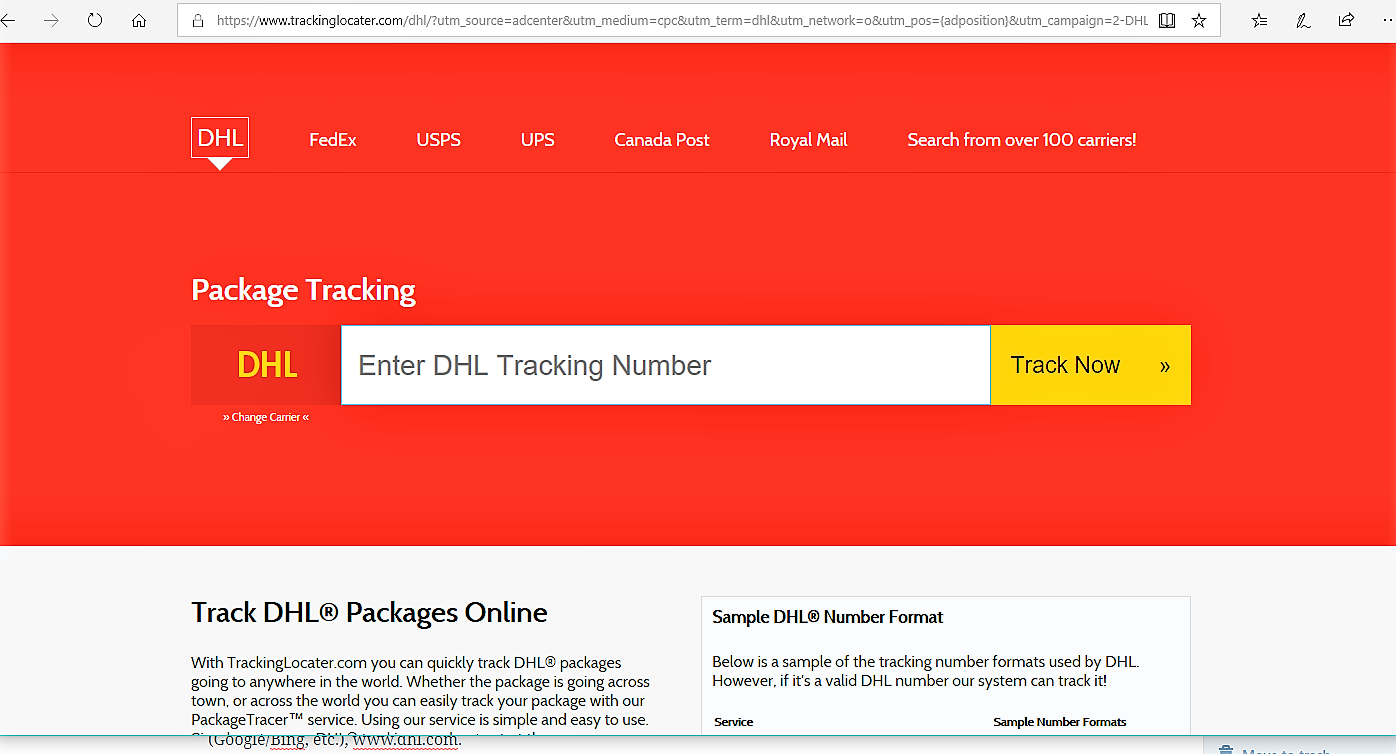
The secure DHL package tracking website looks like this: Real DHL website


April is Keep America Beautiful Month

Since 1953 the Keep America Beautiful (KAB) Foundation works with partners and affiliates nationwide to fulfill its three-fold mission to End Littering, Improve Recycling and Beautify America’s Communities.

KAB’s Great American Cleanup program celebrates it 20th anniversary in 2018, and as the nation’s largest community improvement program, is active in approximately 20,000 communities. In 2017, nearly 5 million volunteers in those communities collected 186 million pounds of litter and debris.

This year, Dow Chemical Company and the Foundation will award $100,000 in grants to municipalities, nonprofits, materials recovery facilities and other qualifying organizations who apply by the June 15, 2018 deadline.

Access grant applications at https://www.kab.org/sites/default/files/program-resources/Hefty%20EnergyBag%20Grant%20Application.docx.

Dow will facilitate planning and implementation of Hefty® Energy Bag programs. The company will provide a blueprint for program development to grant recipients who will manage the programs locally with involvement from key community stakeholders.

Through these grants, plastics that cannot be recycled, such as chip bags and juice pouches, are diverted from landfills and converted into valuable energy resources.

Keep America Beautiful has “600 state and local affiliates, millions of volunteers, and the support of corporate partners, social and civic service organizations, academia, municipalities and government officials.”

To learn more about it, to become an affiliate, and to donate, go to kab.org, or FacebookInstagramTwitter and YouTube.

Affiliates include states like Georgia and Virginia, and cities like San Diego and Stamford, where projects range from planting trees and edibles, cleanups by kids and adults from 9 to 90, even recycling used bottle caps into works of art.

KAB’s resource page, https://www.kab.org/resources, includes youth resources, information and how-to’s on recycling, a model anti-littering ordinance, graffiti prevention guides for homeowners, businesses and a teacher’s guide as well as a report on how to create a community mural.

Keeping America beautiful is a privilege and responsibility that benefits when everyone participates in some way great or small, actively or by donating to the very worthy cause.

Batting a Thousand!

A recent discovery that the bat colony inhabiting the attic of the county sheriff’s department numbers over one thousand has raised serious concerns about the health and safety of deputies working in the second-floor offices.

That bats are and have been hanging around in county buildings is not a surprise, but the nature and seriousness of health hazards posed by their multitudes was rather alarming.

Bats are not pretty, rather they seem creepy, in the eyes of most people. Nevertheless, members of the non-profit Missouri Bat Census and organizations like theirs are quite fond of, and concerned about bats, their safety and ensuring they are treated humanely.

bat_clip_art_18700

Generally speaking, however, anyone of mature years who remembers Count Dracula, or even the younger generation mesmerized by The Vampire Diaries or similar TV shows, may find it hard to resist associating all bats with the blood-sucking creatures of the night.

Yet in real life, bats, and specifically the 14-15 species found in Missouri, are protected under the Wildlife Code of Missouri. Some species are on the U.S. Fish and Wildlife endangered list, among them the gray bat and Indiana bat.

The Missouri Department of Conservation (MDC) views bats in very positive light, dispelling common myths about them: “These beneficial mammals consume tons of insects daily and some act as plant pollinators.” More than 400 products come from bat-pollinated plants, including bananas, avocados, cashews, balsa wood and tequila.

 Further, according to the MDC:

Bats are clean, shy and intelligent creatures. They occupy almost every habitat worldwide and are the primary predator of many insect pests that cause millions of dollars of damage to farms and forests annually.  

At the same time, the department acknowledges the health hazards imposed by a buildup of urine and feces.

Bats look like rodents but they are mammals, as noted above. Their young are born during the May-July time frame, and regulations preclude removing them from their habitat before the young are mature enough to exit their hideaways with the adults.

The recommended way to remove a bat or a few is to build an “exclusion” – a device that allows the bat to exit but prevents re-entry. Not recommended is to use fumigants or repellents, trapping or shooting the bats.

Unless it is damaging property, it is illegal to kill bats. Licensed wildlife (bat) removal services can be found online, operating out of Kansas City, St. Louis, and Springfield, Mo., among others.


The Internet – Transferred or Transformed?

The late Dr. Jonathan B. Postel was an American credited with creating the internet, and for administering the original numbering system under the Internet Assignment of Numbers Authority (IANA).

In a tribute to his work on the tenth anniversary of his death, the Internet Society published the following remarks:

Jon Postel’s technical influence can be seen at the very heart of many of the protocols which make the Internet work: TCP/IP determines the way data is moved through a network; SMTP allows us to send emails; and DNS, the Domain Name Service, help people make sense of the Internet. He contributed to these and many other technologies.

“He was our rock,” said Vint Cerf, shortly after Jon’s death. He was “the foundation on which our every web search and e-mail was built.”

By virtue of Postel’s and his American colleagues’ work and innovations, one could regard the internet as “American.” Or at least otherwise, then indeed for supporters of Al Gore who claimed to have taken “…the initiative in creating the Internet,”  it would be fair to deem the internet an American asset.

Nevertheless, despite efforts of Senators Ted Cruz and Representative Sean Duffy who introducted a bill, “Protecting Internet Freedom Act,” in June this year to block the transfer of the internet to a multinational organization on October 1, 2016, the Obama Administration says the transfer of internet governance will go forward.

Lawrence Strickling, head of the National Telecommunications and Information Administration (NTIA) of the Department of Commerce, said that “barring any significant impediment,” the contract with IANA will expire on October 1. Thereafter, its functions will move to a “global governance model.”

Indeed, on August 10, 2016, the Department of Commerce registered the non-profit corporation, Public Technical Identifiers (PTI), with the California Secretary of State. PTI was formed to perform the naming-related IANA functions.

Identities of the members of the Board of Directors of PTI are not yet published, and it is not known whether they have been appointed, or by whom they will be. PTI will not assume any work until the current contract expires on October 1 [unless a significant impediment arises].

Cruz warns that the transfer will increase the influence of foreign governments, and decrease the influence of the United States over management and control of the internet, and threaten freedom of expression.

For further information, read summaries of Senate Bill 3034 and its companion House Resolution 5418.

In Praise of Possums…

Opossums never inspired much of my time or attention before but lately, more than a few lie dead in or alongside the road. Aside from being accused of “playing possum” as a child, I knew very little about them.

Opossums are not rats!
Before studying them more thoroughly, I had dismissed them as a type of creepy rodent, but alas! Not so – not true at all.

In fact, opossums, or possums as they are often called, not only are NOT rodents, but they are the only marsupials living in the United States and Canada. Like kangaroos that we find more appealing, they are mammals that carry their young in a pouch.

New babies, according to National Geographic, tiny as honeybees, are born after a gestation period of only 12-13 days in litters up to 20 “joeys”, but fewer than half survive to crawl into their mother’s pouch where they are nurtured for about 4 months.

Michael Lipske, writing for National Wildlife Federation (NWF), thinks the opossum is not well thought of because of its long, naked tail. Even so, their tails are part of what makes them unique.

pc_opossum

(Photo from: http://www.caryinstitute.org/sites/default/files/public/images/podcasts/pc_opossum.jpg)

Like monkeys, opossums can wrap their tails around branches to help them climb trees. They can even carry grass and other vegetation—material they use to line their dens—in their coiled tails.

Opossums are not rabies carriers!
Another popular misconception is that possums carry rabies; wrong! In fact, according to the National Opossum Society’s fact page, possums are less susceptible to rabies than cats, dogs, cattle, goats and humans!

Opossums do have their weaknesses…
Yet, they are not perfect or perfectly harmless; they do carry fleas, may sometimes attack chickens and bite people who try to grab them.

They can be bothersome as foragers that knock over trash cans and sneak into pet food when left outside and uncovered. On the other hand, they catch and eat many real pests including cockroaches and beetles, rats and mice, snails and slugs. Opossums also eat roadkill, an activity that often leads to their own deaths.

But also their unique strengths…
NWF suggests we reconsider our feelings about opossums. After all, they eat rattlesnakes and survive their bites. This is significant in that:

Researchers are studying the toxin-neutralizing factor in opossum blood in hopes that it can be adapted as an anti-venom in humans.

Opossums help control Lyme disease!
Cary Institute of Ecosystem Studies report on the Virginia opossum revealed they groom themselves in much the same way as cats. Although they forage in tick-infested areas, they “hoover up” killing 90-95 percent of ticks that try to feed on them. Thus, they are important warriors against Lyme disease.

For the good they do, opossums deserve protection
Opossums “play dead” when frightened by predators, and when facing oncoming traffic in roadways. The National Wildlife Federation found they can maintain a death-pose for hours, even defecating and exuding green slime from anal glands as part of the act.

Ecologists, environmentalists and wildlife experts ask motorists to do their best to go around opossums on the road that appear to be dead, and not to hit them intentionally. They ask homeowners to tolerate them in their yards, noting they stay only 2-3 days in one place, moving frequently between their nesting areas.

Not really that ugly…

Supporters hope word gets out about the contributions opossums make to ecology, the environment and human health. If so, perceptions can change, and people may begin to think of the odd little creatures as a little more attractive!

Heads and minds in the Clouds

Head in the clouds from time to time is not a bad thing, in fact, everyone should take some time away from the troubles of the world. And, while drifting awhile “up there” putting our minds on the clouds can be interesting and informative.

From the windows of an airplane on a recent flight thick layers of clouds scattered here and there looked like handfuls of mini-marshmallows. It’s fun finding familiar shapes in the clouds. And while the Bible speaks metaphorically of a “cloud of witnesses,” sometimes it seems we actually can see human faces and forms looking down from above.

In fourth grade long ago my teacher set up a contest wherein one student’s letter would be chosen and mailed to the National Weather Service to ask for a wall chart of cloud types.

That memory while flying through the marshmallow sky rekindled an interest in clouds. A little research shows that several people have put their minds on clouds and written a lot about them.

For example a certain Brit, Gavin Pretor-Pinney, so loves clouds and cloud-spotting that he formed the Cloud Appreciation Society.  Cloud Appreciation Society

“Friends” from around the world can sign up for free; join as a “Member” for the equivalent of U.S. $12 plus $19.45 annually; or as a “Supporting Member” for $12 plus $35.30 annually. Gift memberships cost $12 plus $14.40 for the first year; the latter three rates also cover shipping of a package of cloud-spotting tools and logos.

CloudSpot AppAnd to bring it all into the digital world, for only $2.99 iPhone owners can download the Society’s cloud-spotting app and explore 40 cloud types and submit photos.

Digital technology makes it possible for anyone interested to capture and share cloud images from wherever they find them. Margaret LeMone, a cloud researcher in the Boulder, Colorado National Center for Atmospheric Research (NCAR), said that cloud enthusiasts can be helpful to meteorologists.

Cloud Collectors HandbookPretor-Pinney also wrote the Cloud Collector’s Handbook, and as reported in June 2009 on NationalGeographic.com, has named what may be the first of a new type of cloud since 1951 – the undulatus asperatus.  Click through the link to see photographs of the thick, rolling-ocean-wave type clouds submitted by laypersons to National Geographic.

National Geographic published a related article in 2010 about studies since the 1940s of hole-punch clouds, the discovery that airplanes create them, and furthermore,  “that aircraft can unleash precipitation by carving the cloud tunnels, which had never before been observed.”

Time magazine online in June 2011 summarized National Center for Atmospheric Research’s (NCAR) studies concluding that more rain and snow fall around commercial airports.

… under certain atmospheric conditions – cloud layers with temperatures about 5 degrees Fahrenheit or lower, for example. When planes fly through these cloud layers, the tips of their propellers make the surrounding air rapidly expand and cool. The supercooled water droplets in the clouds then freeze into ice particles and turn into snow or rain as they fall to the ground, leaving behind both changed weather and the intricate gaps in the clouds….

Apparently, airplanes create new kinds of weather-changing clouds.

Although an old Sonny Bono song declaring that “It’s gonna rain outside, I can tell by the clouds in the sky…,” is one indicator that traditionally, people watched the clouds to predict the weather, those lyrics may have to be updated to say “…I can tell by the clouds and the planes in the sky!”

For now, however, the National Weather Service classifies clouds according to three categories and ten basic types that represent sunny, warm, cold and/or stormy conditions:

  • High clouds
    • Cirrus
    • Cirrostratus
    • Cirrocumulus
  • Mid clouds
    • Altostratus
    • Altocumulus
    • Nimbostratus
  • Low clouds
    • Cumulus
    • Stratus
    • Cumulonimbus
    • Stratocumulus

Kids interested in learning about clouds and how to predict weather by cloud-spotting will find resources online, such as WeatherWizKids.com.

Caution – Turtle Crossing

Google search returned 580,000 responses to the question “Why did the turtle cross the road?” but it is not at all about jokes looking for punchlines.

In fact, female turtles in early summer are often on a mission to return to their familiar nesting grounds with the eggs they carry, as explained in an article by the Mid-Atlantic Turtle & Tortoise Society (MATTS). Others are moving between wetlands habitats, and still other young turtles are searching out a place to live.

The nation’s turtle population declines every year because they are killed by automobiles.  Yet, many drivers and passengers, seeing them on the roads, instinctively want to help them get safely across. MATTS offers tips and for snapping turtles, a video demonstration because of the need for special handling.

Most importantly, drivers must not put themselves in danger on busy roadways. If possible on a road without traffic, let the turtle cross on its own. And, if safe and necessary to help it along, move it by the shortest distance possible, away from the roadside and in the same direction it was headed when first spotted.

Thoughtful motorists will obey speed limits and keep watch for the fascinatingly odd creatures which are the oldest living reptiles on earth.

Read about Missouri’s turtles in the Missouri Department of Conservation report whose cover page is shown below.

MoTurtles


Fourteen (14) of Missouri’s 17 turtle species are protected and on the endangered list.

It is illegal to shoot or in any way to harm or kill protected turtles.

Violations should be reported to local conservation agent, or by toll-free, 24/7 hotline: 1-800-392-1111.

Operation Game Thief  offers rewards from $50 to $1,000 to individuals who wish to be considered for rewards when arrests result from reported actual or suspected wildlife violations.

Individuals may report anonymously, if preferred.

Poaching includes collecting live animals and native species such as turtles, lizards, snakes and frogs – for sale.

Collecting turtles for pets poses a threat to their well-being as well. The stress of an unnatural environment could kill them. Alternatively, marshy areas and woodlands on personal property can provide them a safe and natural environment.

Other facts about turtles reported by the Department of Conservation: they are not harmful to game fish, or to swimmers who leave them undisturbed, and are “beneficial scavengers.”

Missouri driver’s licenses fail DHS test

As of Wednesday, January 13, Missouri driver’s licenses and identification cards (DL/ID) are no longer valid forms of identification for unescorted access to the military base at Fort Leonard Wood, Mo., according to information its Public Affairs Office issued earlier this week.

Valid secondary forms of ID required

Visitors needing emergency services will be allowed a one-time only pass using their Missouri DL/ID through January 27.

Thereafter, visitors must present additional valid ID such as a passport or a certified copy of birth certificate. (Contact the base for a complete list.)

Missouri law vs federal law

The procedural change results from failure to comply with all new criteria for driver’s licenses as specified in the REAL ID Act of 2005 (“the Act”).

Non-compliance deems Missouri’s driver’s licenses and ID cards unacceptable for identification purposes when accessing federal facilities (and nuclear power plants).

In fact, in April 2009, Missouri Governor Jay Nixon signed HB 361 into law to prohibit compliance with the Act.

Identity theft, biometrics, and citizens’ rights

Concerned citizens and lawmakers oppose collction of biometric data such as digital facial recognition images.

Others also, like the Constitutional Alliance , perceive the Act to be in violation of several constitutional rights. Because of its provisions for linking personal information databases nationwide, opponents fear the Act paves the way to a national identification system.

Proponents highlight the fact that several 9/11 terrorists used stolen, duplicate or fake driver’s licenses to board planes they crashed into the Twin Towers and the Pentagon, causing mass destruction of lives and property.

Missouri’s security enhancements fall short…

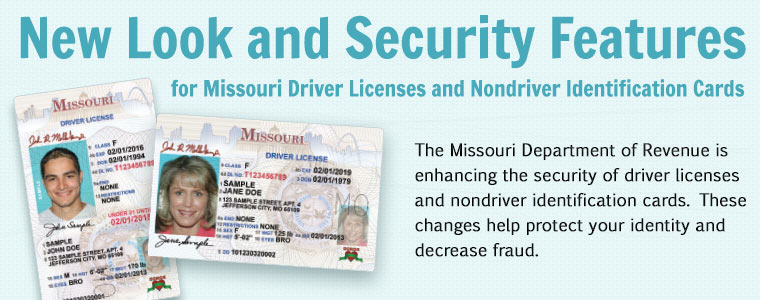
In December 2012, Department of Revenue (DOR) reformatted Missouri driver’s licenses and identification cards with security enhancements to protect against fraud and identity theft.

new-license-features

Processing was centralized and applicants no longer receive new licenses or cards over the counter. Rather, applicants now receive temporary papers good for 30 days while waiting an average of 7-10 days for their new licenses to arrive by mail.

Nevertheless, the Department of Homeland Security (DHS) notified officials in October 2015 that Missouri’s exemptions from implementing the Act would expire on January 10, 2016.

Greatest impact may come later…

In two years on January 22, 2018, Missouri travelers holding non-compliant DL/ID will face problems boarding domestic flights unless they can also present what the TSA deems an acceptable secondary form of identification.

Principle or pragmatism?

In light of the problems Missouri travelers would face in the future if nothing changes, Governor Nixon called for legislative action.

The House Committee on Emerging Issues scheduled a hearing for January 13 to discuss the Act and how best to preserve Missourians’ rights and interests.