WHAT DO YOU KNOW AND HOW MUCH DO YOU CARE …

ABOUT CLIMATE CHANGE?

Please feel free to take part in the Survey linked below that seeks information about your interest in and concerns about climate change.

No personally identifiable information is collected or stored (i.e., your name, age, location, etc.). Completing the survey indicates informed consent. You may decide not to complete the survey at any time. There are 16 questions that should take 10 minutes or less to complete.

Thank you for considering the option to participate.

https://freeonlinesurveys.com/s/SftMky96

Coming Soon: The Great American Eclipse

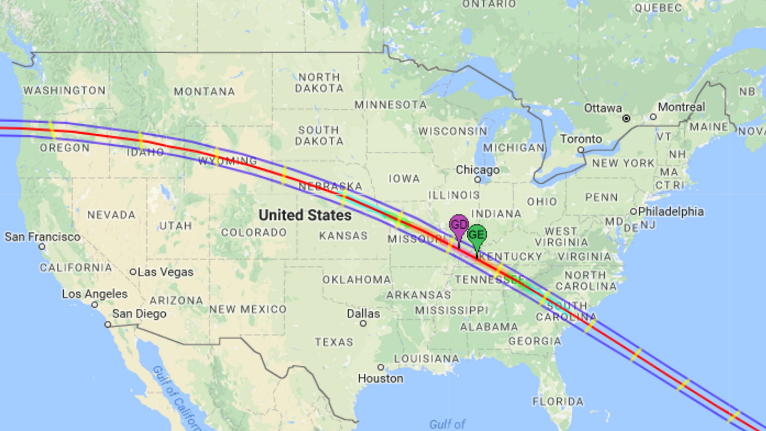
On Monday, August 21, 2017 a solar eclipse will approach Oregon’s coast around 9 a.m. and reach totality by approximately 10:16 a.m., Pacific Time. The ‘Path of Totality’ arcs across the 48 states (CONUS), until approximately 5:04 p.m., Eastern Time.

Skies will darken along the Path that is 60 – 70 miles wide. Weather permitting and with essential protective eye gear, viewers close to the center line of the path will be able to watch as the orbiting moon travels between the earth and sun, completely blocking the sun’s image for about two minutes.

“The Great American Eclipse” is so named because the Path of Totality extends from the West to East Coasts. June 8, 1918, 99 years ago, was the last time a total eclipse was visible across the U.S. However, the rest of the world will see only a partial eclipse.

The Path shown below, from starting point to finish moves across Oregon, Idaho, Wyoming, Nebraska, Missouri, Illinois, Kentucky, Tennessee, Great Smokey Mountain National Park, and South Carolina.

The green “GE” indicates the greatest eclipse point just north of Hopkinsville, Kentucky at 36.97 N and 87.67 W. The red marker “GD” shows the greatest duration point – a few miles south of Carbondale, Illinois at 37.58 N and 89.11 W.

Five state capitals will experience totality: Salem, Oregon; Lincoln, Nebraska; Jefferson City, Missouri; Nashville, Tennessee, and Columbia, South Carolina.

St. Joseph, Missouri, on the center line of the Path, will have 2 min 39 sec of visibility; one of the places with the longest duration. A viewing party at the Rosecrans Memorial Airport is being organized. With speakers lined up and solar telescopes on site, viewers will have the ideal choice to be in the company of astronomers for the special event.

(See https://www.greatamericaneclipse.com/ for information about other eclipse-watching events and to shop for protective eyeglasses.)

Depending on the distance of their locations from the center line, viewers in areas beyond the 60-70 mile wide perimeter may have a partial view.

For example, Warsaw, Mo. is outside the totality path, able to view only a partial eclipse beginning at 11:43 a.m., and reaching maximum intensity at 1:12 p.m.

Jane J. Lee’s article for National Geographic on November 2, 2013, “Solar Eclipse Myths from Around the World,” included an informative 4-minute video (click on photo).

Solar Eclipse 101

North American eclipses occurring in the 21st century on April 8, 2024 and August 12, 2045 are among the several already mapped for enthusiasts and eclipse chasers at https://www.greatamericaneclipse.com/future.

Worldwide eclipses from 2011 through 2060 are mapped out as well; along with a link to a gallery of eclipses from 1651 to 2150.

Batting a Thousand!

A recent discovery that the bat colony inhabiting the attic of the county sheriff’s department numbers over one thousand has raised serious concerns about the health and safety of deputies working in the second-floor offices.

That bats are and have been hanging around in county buildings is not a surprise, but the nature and seriousness of health hazards posed by their multitudes was rather alarming.

Bats are not pretty, rather they seem creepy, in the eyes of most people. Nevertheless, members of the non-profit Missouri Bat Census and organizations like theirs are quite fond of, and concerned about bats, their safety and ensuring they are treated humanely.

bat_clip_art_18700

Generally speaking, however, anyone of mature years who remembers Count Dracula, or even the younger generation mesmerized by The Vampire Diaries or similar TV shows, may find it hard to resist associating all bats with the blood-sucking creatures of the night.

Yet in real life, bats, and specifically the 14-15 species found in Missouri, are protected under the Wildlife Code of Missouri. Some species are on the U.S. Fish and Wildlife endangered list, among them the gray bat and Indiana bat.

The Missouri Department of Conservation (MDC) views bats in very positive light, dispelling common myths about them: “These beneficial mammals consume tons of insects daily and some act as plant pollinators.” More than 400 products come from bat-pollinated plants, including bananas, avocados, cashews, balsa wood and tequila.

 Further, according to the MDC:

Bats are clean, shy and intelligent creatures. They occupy almost every habitat worldwide and are the primary predator of many insect pests that cause millions of dollars of damage to farms and forests annually.  

At the same time, the department acknowledges the health hazards imposed by a buildup of urine and feces.

Bats look like rodents but they are mammals, as noted above. Their young are born during the May-July time frame, and regulations preclude removing them from their habitat before the young are mature enough to exit their hideaways with the adults.

The recommended way to remove a bat or a few is to build an “exclusion” – a device that allows the bat to exit but prevents re-entry. Not recommended is to use fumigants or repellents, trapping or shooting the bats.

Unless it is damaging property, it is illegal to kill bats. Licensed wildlife (bat) removal services can be found online, operating out of Kansas City, St. Louis, and Springfield, Mo., among others.


Weather Patterns – Part Two

This report reflects temperature changes on January 1st, every 5 years from 1945 – 2015 and 2016, in five East Coast cities from Maine to Florida.

Typical climate in the region, in excerpts from world atlas online is described as:

New England states experience warm summers with cool mornings and pleasant evening conditions. Winters in the northeast “…are often quite cold with heavy snow and sub-freezing temperatures…;” and, occasional hurricanes “…strike the eastern coastline and Gulf of Mexico states from June through October.”

Madawaska, Maine is the northernmost city on the East Coast, and Key West, Florida is the southernmost.

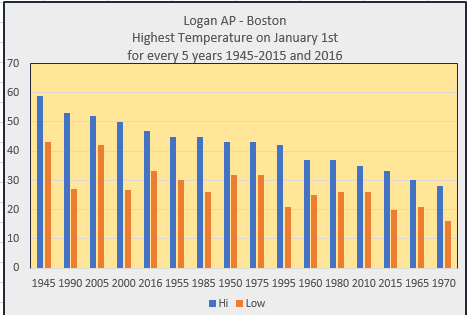
The first chart below shows average highest and lowest temperatures for the cities mentioned above, and for JFK Airport in Jamaica, New York; Logan Airport, Boston, Massachusetts and Norfolk International Airport in Virginia.

5-city-average

The Maine and Florida charts arrange the years in order of the lowest temperatures for each January 1st in the 1945-2015 and 2016 time period. madawaska-temps

Lowest temperature  on January 1 in Maine occurred in 2015; the highest in 1945.

Lowest temperature in Key West on January 1 occurred in 1945. The highest of 84.9°F occurred in 2016; topping the previous high of 84.4°F in 1945.  key-west-temps

JFK and Logan Airport charts list years in order of the highest temperatures for each January 1st in the 1945-2015 and 2016 time frame. jfk-ny-temps

JFK’s New Year’s Day temperature of 61°F in 2005 was the highest on that day in 60 years.

The lowest temperature occurring on the first day of the year in the same period was 21°F in 1970.

Highest January 1st temperature at Logan Airport in Boston was 59°F recorded in 1945.

Boston’s lowest New Year’s Day temperature of 16°F was recorded in 1970. logan-ap-temps


Norfolk International Airport in Virginia is midway between Madawaska and Key West. norfolk-ap

Norfolk’s temperature on January 1, 1985 was the highest recorded for the 71-year period, at 75°F.

Lowest of 25°F was on  January 1, 2015.

Weather Patterns – Part One

Perspectives and laws on a number of issues, including global warming – now climate change, will take interesting turns after January 20, 2017. Indeed, president-elect Trump has held meetings already with Al Gore and Leonardo DiCaprio. Both are high-profile, heavy investors in climate change politics and business.

Therefore, to study national weather patterns is relevant, looking first to Missouri, home of the Enterprise.  Farmer’s Almanac website facilitates searches of daily temperatures by zip code, that the National Climatic Data Center has recorded since January 1, 1945.

According to the National Oceanic and Atmospheric Administration (NOAA) report, Climate in Missouri:

All of Missouri experiences “extreme” climate events and such events must be considered part of the normal climate (http://www.crh.noaa.gov/Image/dvn/downloads/Clim_MO_01.pdf).

Warsaw holds the record for the coldest temperature recorded in Missouri with -40°F on February 13, 1905. Along with Union, Mo., Warsaw also experienced the hottest recorded temperature of 118°F on July 14, 1954.

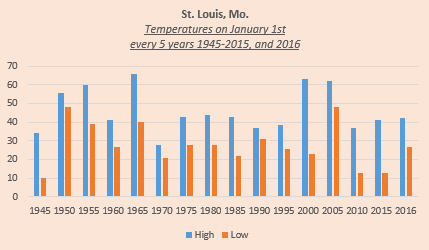
Because of their greater populations and the broader impacts of extreme events (albeit ‘normal’ for Missouri), data on three major cities on January 1st – St. Louis in east Missouri, Kansas City in the west, and Springfield in the south, is highlighted for this study.

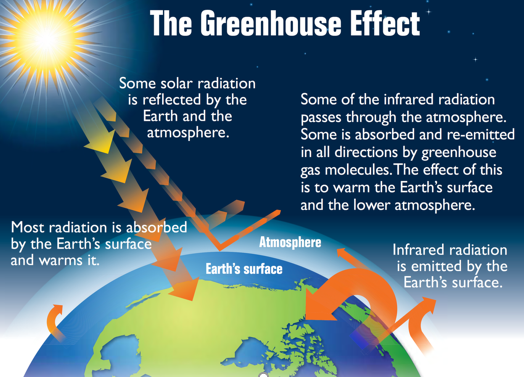
Recall that in January 2006 Al Gore warned that global warming and greenhouse gases left unchecked would destroy the planet within a decade.

greenhouse-effect

Some consider his work suspect. January 22, 2016, Investors.com, published an article entitled: “Five Ways We Know Al Gore’s Been Running A Global Warming Racket.”  (http://www.investors.com/politics/editorials/al-gore-runs-global-warming-racket/).

Others proclaim that Gore has finally been taken seriously. Wired.com’s article on May 24, 2016 claimed: “10 Years After an Inconvenient Truth, Al Gore May Actually Be Winning”  (https://www.wired.com/2016/05/wired-al-gore-climate-change/).

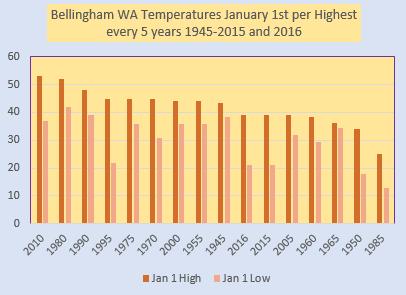
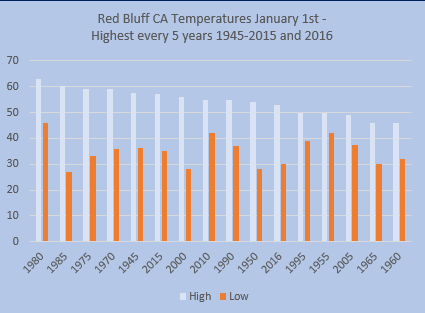
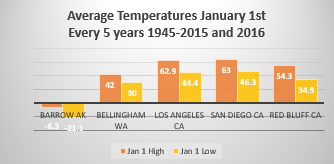
Nevertheless, the charts below tell their own story, at least the part of it about changes over the past 16 years in this part of the country. Not only is the data between and among years useful for detecting trends over time, but the daily temperature changes between high and low are sometimes extreme.

temperature-charts

temperature-chart-2  temperature-chart-3

Part II will look at temperature records for the same time period on the East Coast; and Part III, on the West Coast.

Heads and minds in the Clouds

Head in the clouds from time to time is not a bad thing, in fact, everyone should take some time away from the troubles of the world. And, while drifting awhile “up there” putting our minds on the clouds can be interesting and informative.

From the windows of an airplane on a recent flight thick layers of clouds scattered here and there looked like handfuls of mini-marshmallows. It’s fun finding familiar shapes in the clouds. And while the Bible speaks metaphorically of a “cloud of witnesses,” sometimes it seems we actually can see human faces and forms looking down from above.

In fourth grade long ago my teacher set up a contest wherein one student’s letter would be chosen and mailed to the National Weather Service to ask for a wall chart of cloud types.

That memory while flying through the marshmallow sky rekindled an interest in clouds. A little research shows that several people have put their minds on clouds and written a lot about them.

For example a certain Brit, Gavin Pretor-Pinney, so loves clouds and cloud-spotting that he formed the Cloud Appreciation Society.  Cloud Appreciation Society

“Friends” from around the world can sign up for free; join as a “Member” for the equivalent of U.S. $12 plus $19.45 annually; or as a “Supporting Member” for $12 plus $35.30 annually. Gift memberships cost $12 plus $14.40 for the first year; the latter three rates also cover shipping of a package of cloud-spotting tools and logos.

CloudSpot AppAnd to bring it all into the digital world, for only $2.99 iPhone owners can download the Society’s cloud-spotting app and explore 40 cloud types and submit photos.

Digital technology makes it possible for anyone interested to capture and share cloud images from wherever they find them. Margaret LeMone, a cloud researcher in the Boulder, Colorado National Center for Atmospheric Research (NCAR), said that cloud enthusiasts can be helpful to meteorologists.

Cloud Collectors HandbookPretor-Pinney also wrote the Cloud Collector’s Handbook, and as reported in June 2009 on NationalGeographic.com, has named what may be the first of a new type of cloud since 1951 – the undulatus asperatus.  Click through the link to see photographs of the thick, rolling-ocean-wave type clouds submitted by laypersons to National Geographic.

National Geographic published a related article in 2010 about studies since the 1940s of hole-punch clouds, the discovery that airplanes create them, and furthermore,  “that aircraft can unleash precipitation by carving the cloud tunnels, which had never before been observed.”

Time magazine online in June 2011 summarized National Center for Atmospheric Research’s (NCAR) studies concluding that more rain and snow fall around commercial airports.

… under certain atmospheric conditions – cloud layers with temperatures about 5 degrees Fahrenheit or lower, for example. When planes fly through these cloud layers, the tips of their propellers make the surrounding air rapidly expand and cool. The supercooled water droplets in the clouds then freeze into ice particles and turn into snow or rain as they fall to the ground, leaving behind both changed weather and the intricate gaps in the clouds….

Apparently, airplanes create new kinds of weather-changing clouds.

Although an old Sonny Bono song declaring that “It’s gonna rain outside, I can tell by the clouds in the sky…,” is one indicator that traditionally, people watched the clouds to predict the weather, those lyrics may have to be updated to say “…I can tell by the clouds and the planes in the sky!”

For now, however, the National Weather Service classifies clouds according to three categories and ten basic types that represent sunny, warm, cold and/or stormy conditions:

  • High clouds
    • Cirrus
    • Cirrostratus
    • Cirrocumulus
  • Mid clouds
    • Altostratus
    • Altocumulus
    • Nimbostratus
  • Low clouds
    • Cumulus
    • Stratus
    • Cumulonimbus
    • Stratocumulus

Kids interested in learning about clouds and how to predict weather by cloud-spotting will find resources online, such as WeatherWizKids.com.