Thanksgiving Proclamations

thanksgiving-2

President Barack Obama designated Thursday, November 26, 2015 this year as a National Day of Thanksgiving.

First proclaimed 226 years ago 

George Washington’s Thanksgiving Proclamation in October 1789 set aside the 26th of November that year for

…a day of public thanksgiving and prayer, to be observed by acknowledging with grateful hearts the many and signal favors of Almighty God, especially by affording them an opportunity peaceably to establish a form of government for their safety and happiness…

Missouri’s first Thanksgiving proclamation

Digital Heritage archives with the Missouri Secretary of State show that Governor Thomas Reynolds (1840-1844) issued the state’s first Thanksgiving Day proclamation. On October 16, 1843, he set aside the fourth Thursday in November.

[N.B.: Notwithstanding Reynolds’ many noteworthy accomplishments, the archive reveals that his life ended tragically.]

Every year since 1863

Exactly 74 years after Washington’s proclamation on October 3, 1863, President Abraham Lincoln issued his Thanksgiving Proclamation marking the last day of November

“… as a day of Thanksgiving and Praise to our beneficent Father who dwelleth in the Heavens…”

Bumps on the road to a federal holiday

In 1939 Thanksgiving Day would have fallen on the last day of November. That year, President Franklin Roosevelt proclaimed a change in date to the second to last Thursday in November.

The economy was in a recovery period and Roosevelt wanted to avoid stunting the turnaround by cutting short the Christmas shopping season.

Thirty-two states followed suit, but 16 refused to do so. For two years one group celebrated Thanksgiving on one day, and the other celebrated on another.

Finally…
amendment-l

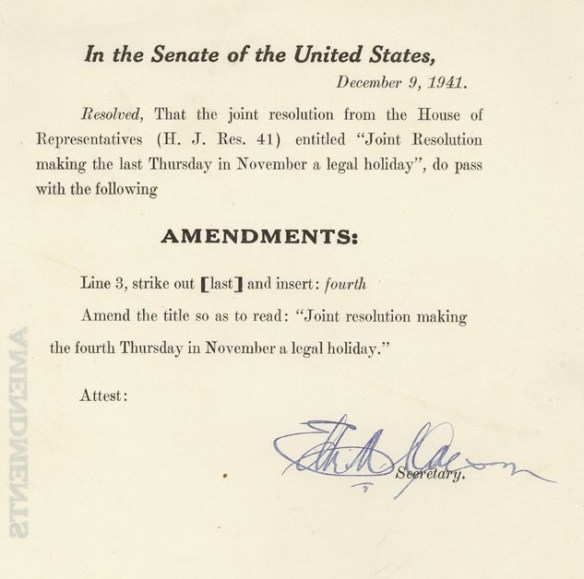
On December 26, 1941, Roosevelt signed the amended joint resolution proclaiming the fourth Thursday of November as Thanksgiving Day.

Veterans Day

At 11 a.m. on November 11, 1918, Germany signed an armistice with the Allies, officially ending World War I.  VeteransDay

President Woodrow Wilson in 1919 designated November 11 as Armistice Day, a holiday for reflection on the sacrifice and service of military members who served in WWI.

That “war to end all wars” did not not up to the promise. Benjamin Weeks, a World War II veteran from Birmingham, Alabama, petitioned General Eisenhower in 1945 to change the holiday’s name to Veterans Day.

By an act of Congress, the name was changed in June 1954.

Jeff Schogol wrote about Weeks in Stars and Stripes (November 18, 2011). He noted that in 1947 Birmingham celebrated “National Veterans Day” on November 11, inspired by Weeks’ efforts to honor all veterans.

Weeks received the Presidential Citizens Medal in 1982. President Reagan credited him then for being:

…the driving force behind the congressional action which in 1954 established this special holiday as a day to honor all American veterans.

Veterans Day specials

Denny’s restaurant at 2401 Broadway in Sedalia, Mo. offers free Build Your Own Grand Slam on November 11 between 5 a.m. and noon  to service members showing valid military ID. In-house dining only.

Golden Corral sponsors Military Appreciation Night from 5 to 9 p.m. providing free “thank you” dinners to past or present members of the U.S. military, including National Guard and Reserves. In-house dining only.

Presidential proclamation

On November 5, 2015, the White House released President Barack Obama’s Veterans Day proclamation.

Lincoln Post office reopens

FullSizeRender (632x612)Monday morning, November 2, 2015, the Lincoln, Mo. post office reopened to the public. A fire on May 10 this year, as reported in the print and online editions of the Enterprise, had devastated the building’s interior.

More work remains to do to put everything back in place, but progress so far in the brand new look of things can be readily seen and appreciated.


P O Entrance

P O Boxes

Walls are painted, floors are shining; the air is fresh. Keys are on hand for new mailboxes installed in the foyer.

Retail hours are Weekdays from 8:30 a.m. to 4:00 p.m. Be sure to congratulate the staff on their return to normal operations and thank them for their dedication through the recent difficult times.

Dollar General opening new stores in Warsaw – Updates!

Business owners along East Main Street are excited to see signs that the Dollar General store relocation and expansion they’ve waited for so long will soon bring new life and hope to the depressed looking area.

Friday, Oct 23

DG New

Preps began this week for expansion-relocation of Dollar General store.

Wednesday, Oct 28

DG Site Cleared

Construction is also underway for a new Dollar General store on the hilltop along MO-7 where Advantage Real Estate office used to be.

Monster.com reported in March this year that Dollar General would open 730 new stores in 2015 and remodel 875 others. Such an aggressive expansion plan opens the door to several job opportunities.

Dollar General will be hiring sales associates, cashiers, stockers, shift leaders, assistant, store and district managers, store merchandisers, warehouse supervisors, operations managers and inbound/outbound managers among others.

Salary and benefits

  • Average entry-level positions pay $8 to $9 per hour.
  • Supervisory and managerial positions pay $12 to $18 per hour.
  • Rates and bonuses increase depending on skills and experience.
  • Regular overtime and holiday rates.
  • Raises, bonuses, free products and item discounts.

Check out Monster’s job listings from Dollar General Stores in Missouri here, and the Dollar General Newsroom for up-to-date reports on careers and company business, including financials and community service projects.

DG news

Selected Economic Indicators for Missouri and the Plains States

Gross domestic product (GDP) means:                         Plains States

…total value of goods and services produced during a period not including foreign earned income.

Bureau of Economic Analysis (BEA) 2014 data on changes in GDP in Missouri and the other six (6) Plains States shows an average 1.3 percent growth, considerably lower than the 2.2 percent national average.

  • Missouri                                                                    0.9
  • North Dakota                                                           6.3
  • South Dakota                                                           0.6
  • Nebraska                                                                   0.7
  • Kansas                                                                       1.8
  • Iowa                                                                           0.4
  • Minnesota                                                                 1.4

But there is a side to the economic story besides GDP. Alan Cole and Scott Drenkard wrote July 8, 2015 about “The Real Value of $100 in Each State.”

The value of goods purchased for every $100 spent varies from state to state and the District of Columbia.

Cole and Drenkard noted the often direct relationship between higher income and higher prices, but not always. For example, North Dakotans earn higher income but pay lower prices.

Adjusting incomes for price level can substantially change our perceptions of which states are truly poor or rich.              

Nationwide the District of Columbia had lowest purchasing power per $100 based on 2013 numbers – at $84.96; and Mississippi had the greatest with $115.21.

Median household income (2014) in the District of Columbia is fifth highest in the country at $65,124, yet the high cost of goods and services reduces purchasing power by almost $10,000.

On the other hand, Mississippi has the lowest median income (2014) among the fifty states and the District of Columbia – at $36,919. Yet, lower prices increase its purchasing power by more than $5,600.

Likewise, Missouri’s relatively low prices increase purchasing power of its median income (2014) of $45,247 by nearly $5,500.

The seven (7) Plains States enjoy greater purchasing power than most states with higher median incomes. For each $100 spent, value of goods and services is:

  • Missouri                              $112.11
  •  North Dakota                     $109.41
  • South Dakota                     $114.16
  •  Nebraska                             $110.50
  • Kansas                                 $110.13
  • Iowa                                     $110.74
  • Minnesota                          $102.46

Personal Income Changes in Plains States: First Quarter 2015

Average nationwide personal income growth was 0.9 percent. The private sector suffered 0.6 percent income loss compared to the last quarter (Oct-Dec) 2014, but government sector income grew by 0.5 percent in the same period.

Farm income declined in the Plains States of South Dakota, Nebraska, Kansas and Iowa. Iowa personal income declined 1.2 percent in the first three months of the year, more than any other state.

Missouri personal income increased by about one percent, and Minnesota personal income increased by less than one percent.

Missouri rules of the road for bikes and cars

bike-rider-1-13809-mediumA Warsaw man whose bicycle is frequently his mode of transportation told of a dangerous incident he experienced with a motorist this week.

He (bicyclist) was rounding an uphill curve on a narrow city street near a main traffic-lighted intersection. While going up and around the curve he rode to the center of the lane as a safety measure.

Unexpectedly, an impatient driver in a car behind him began shouting expletives at him, then drove his car angrily around and past him.

Still fuming from the minute-long inconvenience, the motorist pulled over onto the side of the road just past the intersection, got out of his car and waited. He then threatened the bicyclist physically when the latter approached the same spot. Apparently, the motorist had no time to slow down for a minute or two, but had quite enough time to pull over, wait and engage in verbal if not physical confrontation.

For his part, the bicyclist dismounted, and putting the bicycle between himself and the angry driver, suggested convincingly that the motorist reconsider his intentions. Thankfully, that was the end of it, and they each went on their way.

Warsaw prides itself – at least its city officials and peace-loving citizens do – in the fact that it is a bicycle-friendly community. Specially-designed bike trails, bike paths already existing and more planned along city streets and roadways, encourage people to ride their bikes more and more often. Championship bike races are held in Warsaw, and hopefully soon it will be designated Missouri’s official championship site.

Very likely the motorist vs bicyclist scenario described above happens often. The driver of a car should not pull out in front of a moving bicycle to pass in an unsafe way. A violation of RSMo 304.678.1 is an infraction of the law, but becomes a misdemeanor if an accident results.

Bicycles moving slower than other traffic should stay on the right side of the roadway as often as is safe. Yet, there are exceptions when bicyclists are following the law by moving to the center of a lane for safety reasons (RSMo 304.016.4).

Motorists and bicyclists need to inform themselves of Missouri rules of the road. Some may be surprised to learn that “Every person riding a bicycle or motorized bicycle upon a street or highway shall be granted all of the rights and shall be subject to all of the duties applicable to the driver of a vehicle…” (RSMo 307.188).

In the same way as for other motorists, when a vehicle driver needs to make a right turn and is following behind a bicyclist, the motorist is supposed to slow down and wait until the turn can be made safely. Safety, not speed, is most important in all circumstances.

A Summary of Missouri State Statutes Related to Bicycling is helpful and informative for bicyclists and motorists to understand their rights and responsibilities toward each other.

Federal and State Internet Sales Taxes

Six months ago Michigan Governor Snyder signed into law the “Main Street Fairness Act.” Beginning on October 1, 2015 online retailers in the state must collect and remit 6 percent sales tax just as retailers with a physical presence do.

Source: Detroit Free Press.

PC World reported on November 14, 2014 that Speaker John Boehner opposed the Act and would bring no action on it before the end of last year’s Congressional session. The Senate passed an internet sales tax under the “Marketplace Fairness Act” in 2013 but House Republicans blocked its passage.

This year on June 15, 2015, however, Utah Republican Congressman Jason Chaffetz introduced a new version as “The Remote Transactions Parity Act.” His bill provides that:

  • States would have to provide the software to sellers that have no physical presence so they can calculate taxes owed on purchases made by residents of other states;
  • Small businesses with sales under $10 million would be exempt in the first year; businesses with sales under $5 million would be exempt in the second year; and those with sales under $1 million would be exempt in the third year.
  • No businesses exempt after the third year, but those with less than $5 million sales do not have to be audited for compliance with the tax requirements.

The Heritage Foundation points out that small businesses would have to bear a heavy burden to collect and account for sales taxes from more than 10,000 jurisdictions. Additionally, in 1992 the Supreme Court ruled in Quill vs. North Dakota that states can only tax businesses with a physical presence within their boundaries (http://dailysignal.com/2015/06/23/whats- wrong-with-the-latest-internet-sales-tax-bill/).

According to the Daily Signal, large online retailers such as Overstock and Amazon support Chaffetz’s bill as a means to establish a federal standard. Those who support the imposition of internet sales taxes claim it is necessary to keep the tax rules fair for local and remote businesses.

H.R. 2775 was assigned to the House Judiciary Committee, and on July 1, 2015 went to the Subcommittee on Regulatory Reform, Commercial and Antitrust Law. The bill has 18 Republican sponsors and 15 Democrat sponsors. Request alerts on the status of the bill here.

Although sponsors from the federal level do not include any from Missouri, on the state level Warren Love (R-Mo.) expressed his support for an internet sales tax when he stopped by the old Chamber of Commerce building in Warsaw last October. At the time, he referred to it as an untapped source of revenue for Missouri, and asked Congresswoman Hartzler who was meeting with the Chamber Board members that afternoon to consider supporting internet sales tax legislation if and when it were introduced.