Batting a Thousand!

A recent discovery that the bat colony inhabiting the attic of the county sheriff’s department numbers over one thousand has raised serious concerns about the health and safety of deputies working in the second-floor offices.

That bats are and have been hanging around in county buildings is not a surprise, but the nature and seriousness of health hazards posed by their multitudes was rather alarming.

Bats are not pretty, rather they seem creepy, in the eyes of most people. Nevertheless, members of the non-profit Missouri Bat Census and organizations like theirs are quite fond of, and concerned about bats, their safety and ensuring they are treated humanely.

bat_clip_art_18700

Generally speaking, however, anyone of mature years who remembers Count Dracula, or even the younger generation mesmerized by The Vampire Diaries or similar TV shows, may find it hard to resist associating all bats with the blood-sucking creatures of the night.

Yet in real life, bats, and specifically the 14-15 species found in Missouri, are protected under the Wildlife Code of Missouri. Some species are on the U.S. Fish and Wildlife endangered list, among them the gray bat and Indiana bat.

The Missouri Department of Conservation (MDC) views bats in very positive light, dispelling common myths about them: “These beneficial mammals consume tons of insects daily and some act as plant pollinators.” More than 400 products come from bat-pollinated plants, including bananas, avocados, cashews, balsa wood and tequila.

 Further, according to the MDC:

Bats are clean, shy and intelligent creatures. They occupy almost every habitat worldwide and are the primary predator of many insect pests that cause millions of dollars of damage to farms and forests annually.  

At the same time, the department acknowledges the health hazards imposed by a buildup of urine and feces.

Bats look like rodents but they are mammals, as noted above. Their young are born during the May-July time frame, and regulations preclude removing them from their habitat before the young are mature enough to exit their hideaways with the adults.

The recommended way to remove a bat or a few is to build an “exclusion” – a device that allows the bat to exit but prevents re-entry. Not recommended is to use fumigants or repellents, trapping or shooting the bats.

Unless it is damaging property, it is illegal to kill bats. Licensed wildlife (bat) removal services can be found online, operating out of Kansas City, St. Louis, and Springfield, Mo., among others.


In Praise of Possums…

Opossums never inspired much of my time or attention before but lately, more than a few lie dead in or alongside the road. Aside from being accused of “playing possum” as a child, I knew very little about them.

Opossums are not rats!
Before studying them more thoroughly, I had dismissed them as a type of creepy rodent, but alas! Not so – not true at all.

In fact, opossums, or possums as they are often called, not only are NOT rodents, but they are the only marsupials living in the United States and Canada. Like kangaroos that we find more appealing, they are mammals that carry their young in a pouch.

New babies, according to National Geographic, tiny as honeybees, are born after a gestation period of only 12-13 days in litters up to 20 “joeys”, but fewer than half survive to crawl into their mother’s pouch where they are nurtured for about 4 months.

Michael Lipske, writing for National Wildlife Federation (NWF), thinks the opossum is not well thought of because of its long, naked tail. Even so, their tails are part of what makes them unique.

pc_opossum

(Photo from: http://www.caryinstitute.org/sites/default/files/public/images/podcasts/pc_opossum.jpg)

Like monkeys, opossums can wrap their tails around branches to help them climb trees. They can even carry grass and other vegetation—material they use to line their dens—in their coiled tails.

Opossums are not rabies carriers!
Another popular misconception is that possums carry rabies; wrong! In fact, according to the National Opossum Society’s fact page, possums are less susceptible to rabies than cats, dogs, cattle, goats and humans!

Opossums do have their weaknesses…
Yet, they are not perfect or perfectly harmless; they do carry fleas, may sometimes attack chickens and bite people who try to grab them.

They can be bothersome as foragers that knock over trash cans and sneak into pet food when left outside and uncovered. On the other hand, they catch and eat many real pests including cockroaches and beetles, rats and mice, snails and slugs. Opossums also eat roadkill, an activity that often leads to their own deaths.

But also their unique strengths…
NWF suggests we reconsider our feelings about opossums. After all, they eat rattlesnakes and survive their bites. This is significant in that:

Researchers are studying the toxin-neutralizing factor in opossum blood in hopes that it can be adapted as an anti-venom in humans.

Opossums help control Lyme disease!
Cary Institute of Ecosystem Studies report on the Virginia opossum revealed they groom themselves in much the same way as cats. Although they forage in tick-infested areas, they “hoover up” killing 90-95 percent of ticks that try to feed on them. Thus, they are important warriors against Lyme disease.

For the good they do, opossums deserve protection
Opossums “play dead” when frightened by predators, and when facing oncoming traffic in roadways. The National Wildlife Federation found they can maintain a death-pose for hours, even defecating and exuding green slime from anal glands as part of the act.

Ecologists, environmentalists and wildlife experts ask motorists to do their best to go around opossums on the road that appear to be dead, and not to hit them intentionally. They ask homeowners to tolerate them in their yards, noting they stay only 2-3 days in one place, moving frequently between their nesting areas.

Not really that ugly…

Supporters hope word gets out about the contributions opossums make to ecology, the environment and human health. If so, perceptions can change, and people may begin to think of the odd little creatures as a little more attractive!

Caution – Turtle Crossing

Google search returned 580,000 responses to the question “Why did the turtle cross the road?” but it is not at all about jokes looking for punchlines.

In fact, female turtles in early summer are often on a mission to return to their familiar nesting grounds with the eggs they carry, as explained in an article by the Mid-Atlantic Turtle & Tortoise Society (MATTS). Others are moving between wetlands habitats, and still other young turtles are searching out a place to live.

The nation’s turtle population declines every year because they are killed by automobiles.  Yet, many drivers and passengers, seeing them on the roads, instinctively want to help them get safely across. MATTS offers tips and for snapping turtles, a video demonstration because of the need for special handling.

Most importantly, drivers must not put themselves in danger on busy roadways. If possible on a road without traffic, let the turtle cross on its own. And, if safe and necessary to help it along, move it by the shortest distance possible, away from the roadside and in the same direction it was headed when first spotted.

Thoughtful motorists will obey speed limits and keep watch for the fascinatingly odd creatures which are the oldest living reptiles on earth.

Read about Missouri’s turtles in the Missouri Department of Conservation report whose cover page is shown below.

MoTurtles


Fourteen (14) of Missouri’s 17 turtle species are protected and on the endangered list.

It is illegal to shoot or in any way to harm or kill protected turtles.

Violations should be reported to local conservation agent, or by toll-free, 24/7 hotline: 1-800-392-1111.

Operation Game Thief  offers rewards from $50 to $1,000 to individuals who wish to be considered for rewards when arrests result from reported actual or suspected wildlife violations.

Individuals may report anonymously, if preferred.

Poaching includes collecting live animals and native species such as turtles, lizards, snakes and frogs – for sale.

Collecting turtles for pets poses a threat to their well-being as well. The stress of an unnatural environment could kill them. Alternatively, marshy areas and woodlands on personal property can provide them a safe and natural environment.

Other facts about turtles reported by the Department of Conservation: they are not harmful to game fish, or to swimmers who leave them undisturbed, and are “beneficial scavengers.”

FBI collects animal cruelty data

Persons guilty of animal cruelty are frequently involved in other criminal activity, and often, also commit violent crimes against humans.

In January 2015 the Federal Bureau of Investigation (FBI) began year-long preparations to collect data on these crimes.

The National Sheriffs’ Association (NSA) and the Animal Welfare Institute (AWI) worked in partnership with the FBI to implement the program.

Animal cruelty cases were previously included among “All Other Crimes” in the FBI’s Uniform Crime Report (UCR). Since 2014, however, animal cruelty is categorized as a Group A crime along with arson, assault and homicide.

AWI had lobbied the FBI for 12 years to make the change.

NIBRS

As of January 1, 2016 the FBI is adding acts of animal cruelty to its National Incident-Based Reporting System (NIBRS). The information will be available to the public in 2017.

NIBRS data will include incidents and arrests as required for four kinds of animal cruelty:

  • simple/gross neglect;
  • intentional abuse and torture;
  • organized abuse; and
  • animal sexual abuse.

The National Sheriff’s Association website highlights its National Law Enforcement Center on Animal Abuse.  The NLECAA serves to:

…bring greater awareness to, and understanding by, our nation’s law enforcement officers on the oftentimes misunderstood nature of animal abuse crimes and their link to violence against humans.

The Center provides information and training for officers to equip them for enforcing the animal abuse laws within their jurisdictions.

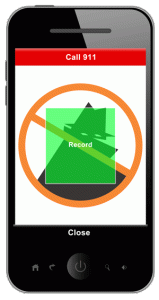
ICE_NSA_PhoneSmartphone app for reporting animal abuse

In addition, the NSA and the Humane Society of the United States launched a smartphone app for Apple and Android – available free to the public.

NSA Executive Director, John Thompson, said:

…we are using the latest in technology to help catch animal abusers in the act. We encourage everyone who has a smartphone and cares about protecting animals and our communities to download this new app.

Witnesses to animal abuse can make a video to submit to the NSA.  The Humane Society pays the costs to follow up on the case.  An agent will notify local authorities and animal services to retrieve the animal, and the district attorney to file charges.

Missouri laws on animal abuse

Chapter 578 of the Revised Missouri Statutes categorizes animal abuse under “Miscellaneous Offenses.” Changes that will take effect on January 1, 2017 are separately identified.

The Humane Society of Missouri operates an Animal Cruelty Task Force that serves 114 counties and the City of St. Louis.

The Task Force responds to disasters affecting animals, investigates reports of abuse, unlicensed puppy mills, pet hoarding, and mistreatment of farm animals.Animal Cruelty Hotline

Call the number on the banner to report abuse, or report incidents online here.