WHAT DO YOU KNOW AND HOW MUCH DO YOU CARE …

ABOUT CLIMATE CHANGE?

Please feel free to take part in the Survey linked below that seeks information about your interest in and concerns about climate change.

No personally identifiable information is collected or stored (i.e., your name, age, location, etc.). Completing the survey indicates informed consent. You may decide not to complete the survey at any time. There are 16 questions that should take 10 minutes or less to complete.

Thank you for considering the option to participate.

https://freeonlinesurveys.com/s/SftMky96

April is Keep America Beautiful Month

Since 1953 the Keep America Beautiful (KAB) Foundation works with partners and affiliates nationwide to fulfill its three-fold mission to End Littering, Improve Recycling and Beautify America’s Communities.

KAB’s Great American Cleanup program celebrates it 20th anniversary in 2018, and as the nation’s largest community improvement program, is active in approximately 20,000 communities. In 2017, nearly 5 million volunteers in those communities collected 186 million pounds of litter and debris.

This year, Dow Chemical Company and the Foundation will award $100,000 in grants to municipalities, nonprofits, materials recovery facilities and other qualifying organizations who apply by the June 15, 2018 deadline.

Access grant applications at https://www.kab.org/sites/default/files/program-resources/Hefty%20EnergyBag%20Grant%20Application.docx.

Dow will facilitate planning and implementation of Hefty® Energy Bag programs. The company will provide a blueprint for program development to grant recipients who will manage the programs locally with involvement from key community stakeholders.

Through these grants, plastics that cannot be recycled, such as chip bags and juice pouches, are diverted from landfills and converted into valuable energy resources.

Keep America Beautiful has “600 state and local affiliates, millions of volunteers, and the support of corporate partners, social and civic service organizations, academia, municipalities and government officials.”

To learn more about it, to become an affiliate, and to donate, go to kab.org, or FacebookInstagramTwitter and YouTube.

Affiliates include states like Georgia and Virginia, and cities like San Diego and Stamford, where projects range from planting trees and edibles, cleanups by kids and adults from 9 to 90, even recycling used bottle caps into works of art.

KAB’s resource page, https://www.kab.org/resources, includes youth resources, information and how-to’s on recycling, a model anti-littering ordinance, graffiti prevention guides for homeowners, businesses and a teacher’s guide as well as a report on how to create a community mural.

Keeping America beautiful is a privilege and responsibility that benefits when everyone participates in some way great or small, actively or by donating to the very worthy cause.

Batting a Thousand!

A recent discovery that the bat colony inhabiting the attic of the county sheriff’s department numbers over one thousand has raised serious concerns about the health and safety of deputies working in the second-floor offices.

That bats are and have been hanging around in county buildings is not a surprise, but the nature and seriousness of health hazards posed by their multitudes was rather alarming.

Bats are not pretty, rather they seem creepy, in the eyes of most people. Nevertheless, members of the non-profit Missouri Bat Census and organizations like theirs are quite fond of, and concerned about bats, their safety and ensuring they are treated humanely.

bat_clip_art_18700

Generally speaking, however, anyone of mature years who remembers Count Dracula, or even the younger generation mesmerized by The Vampire Diaries or similar TV shows, may find it hard to resist associating all bats with the blood-sucking creatures of the night.

Yet in real life, bats, and specifically the 14-15 species found in Missouri, are protected under the Wildlife Code of Missouri. Some species are on the U.S. Fish and Wildlife endangered list, among them the gray bat and Indiana bat.

The Missouri Department of Conservation (MDC) views bats in very positive light, dispelling common myths about them: “These beneficial mammals consume tons of insects daily and some act as plant pollinators.” More than 400 products come from bat-pollinated plants, including bananas, avocados, cashews, balsa wood and tequila.

 Further, according to the MDC:

Bats are clean, shy and intelligent creatures. They occupy almost every habitat worldwide and are the primary predator of many insect pests that cause millions of dollars of damage to farms and forests annually.  

At the same time, the department acknowledges the health hazards imposed by a buildup of urine and feces.

Bats look like rodents but they are mammals, as noted above. Their young are born during the May-July time frame, and regulations preclude removing them from their habitat before the young are mature enough to exit their hideaways with the adults.

The recommended way to remove a bat or a few is to build an “exclusion” – a device that allows the bat to exit but prevents re-entry. Not recommended is to use fumigants or repellents, trapping or shooting the bats.

Unless it is damaging property, it is illegal to kill bats. Licensed wildlife (bat) removal services can be found online, operating out of Kansas City, St. Louis, and Springfield, Mo., among others.


Weather Patterns – Part Two

This report reflects temperature changes on January 1st, every 5 years from 1945 – 2015 and 2016, in five East Coast cities from Maine to Florida.

Typical climate in the region, in excerpts from world atlas online is described as:

New England states experience warm summers with cool mornings and pleasant evening conditions. Winters in the northeast “…are often quite cold with heavy snow and sub-freezing temperatures…;” and, occasional hurricanes “…strike the eastern coastline and Gulf of Mexico states from June through October.”

Madawaska, Maine is the northernmost city on the East Coast, and Key West, Florida is the southernmost.

The first chart below shows average highest and lowest temperatures for the cities mentioned above, and for JFK Airport in Jamaica, New York; Logan Airport, Boston, Massachusetts and Norfolk International Airport in Virginia.

5-city-average

The Maine and Florida charts arrange the years in order of the lowest temperatures for each January 1st in the 1945-2015 and 2016 time period. madawaska-temps

Lowest temperature  on January 1 in Maine occurred in 2015; the highest in 1945.

Lowest temperature in Key West on January 1 occurred in 1945. The highest of 84.9°F occurred in 2016; topping the previous high of 84.4°F in 1945.  key-west-temps

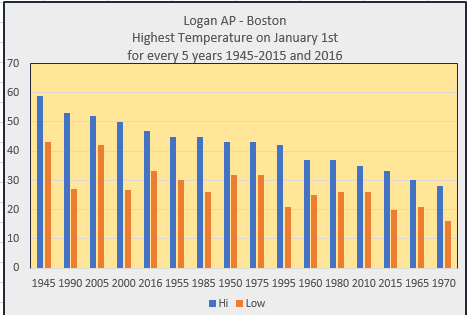
JFK and Logan Airport charts list years in order of the highest temperatures for each January 1st in the 1945-2015 and 2016 time frame. jfk-ny-temps

JFK’s New Year’s Day temperature of 61°F in 2005 was the highest on that day in 60 years.

The lowest temperature occurring on the first day of the year in the same period was 21°F in 1970.

Highest January 1st temperature at Logan Airport in Boston was 59°F recorded in 1945.

Boston’s lowest New Year’s Day temperature of 16°F was recorded in 1970. logan-ap-temps


Norfolk International Airport in Virginia is midway between Madawaska and Key West. norfolk-ap

Norfolk’s temperature on January 1, 1985 was the highest recorded for the 71-year period, at 75°F.

Lowest of 25°F was on  January 1, 2015.

Weather Patterns – Part One

Perspectives and laws on a number of issues, including global warming – now climate change, will take interesting turns after January 20, 2017. Indeed, president-elect Trump has held meetings already with Al Gore and Leonardo DiCaprio. Both are high-profile, heavy investors in climate change politics and business.

Therefore, to study national weather patterns is relevant, looking first to Missouri, home of the Enterprise.  Farmer’s Almanac website facilitates searches of daily temperatures by zip code, that the National Climatic Data Center has recorded since January 1, 1945.

According to the National Oceanic and Atmospheric Administration (NOAA) report, Climate in Missouri:

All of Missouri experiences “extreme” climate events and such events must be considered part of the normal climate (http://www.crh.noaa.gov/Image/dvn/downloads/Clim_MO_01.pdf).

Warsaw holds the record for the coldest temperature recorded in Missouri with -40°F on February 13, 1905. Along with Union, Mo., Warsaw also experienced the hottest recorded temperature of 118°F on July 14, 1954.

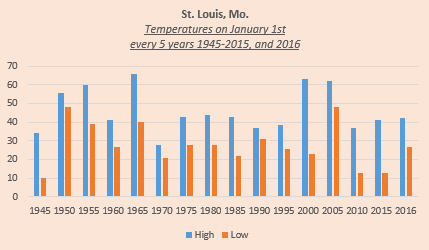
Because of their greater populations and the broader impacts of extreme events (albeit ‘normal’ for Missouri), data on three major cities on January 1st – St. Louis in east Missouri, Kansas City in the west, and Springfield in the south, is highlighted for this study.

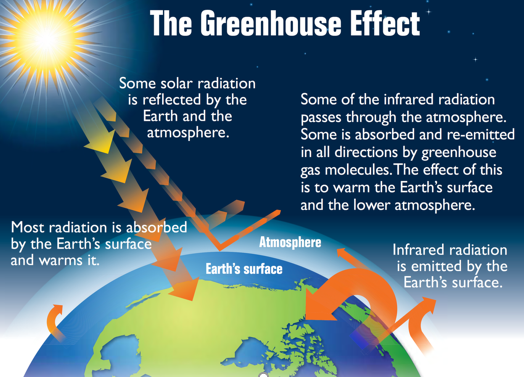
Recall that in January 2006 Al Gore warned that global warming and greenhouse gases left unchecked would destroy the planet within a decade.

greenhouse-effect

Some consider his work suspect. January 22, 2016, Investors.com, published an article entitled: “Five Ways We Know Al Gore’s Been Running A Global Warming Racket.”  (http://www.investors.com/politics/editorials/al-gore-runs-global-warming-racket/).

Others proclaim that Gore has finally been taken seriously. Wired.com’s article on May 24, 2016 claimed: “10 Years After an Inconvenient Truth, Al Gore May Actually Be Winning”  (https://www.wired.com/2016/05/wired-al-gore-climate-change/).

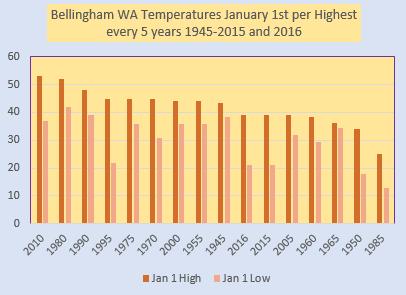
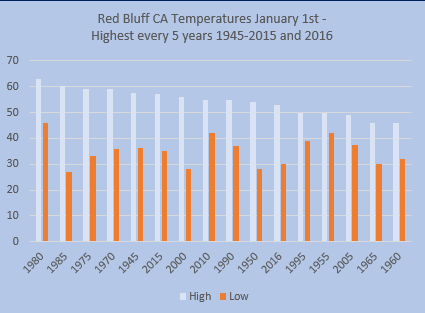
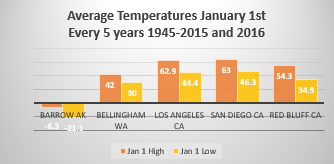
Nevertheless, the charts below tell their own story, at least the part of it about changes over the past 16 years in this part of the country. Not only is the data between and among years useful for detecting trends over time, but the daily temperature changes between high and low are sometimes extreme.

temperature-charts

temperature-chart-2  temperature-chart-3

Part II will look at temperature records for the same time period on the East Coast; and Part III, on the West Coast.