“I could win…”

So says President Obama about his prospects for a third term.  During a July 28 speech in Ethiopia he said:

“I actually think I’m a pretty good president,” he said with a smile. “I think if I ran I could win. But I can’t. … The law is the law, and no one person is above the law, not even the president.”

CNN.com, QZ. com, RT.com are among online news sources around the world that quoted and commented on the president’s remarks. Another, NPR.com suggested that given the president’s recently rising approval ratings and the Obama team’s successful campaigning tactics, he very well could win an third term if only the 22nd Amendment that sets a limit of two terms did not stand in the way.

ObamaEthiopia

             Photo by Mulugeta Ayene/AP

Donald Trump, one of the GOP candidates President Obama has criticized while in Africa, spoke earlier this week with Greta van Susteren on a variety of topics. At about 11 minutes into the 15-minute interview Trump gave his opinion on Obama’s hypothetical third term.

What bird is this?

Last week a strange bird came walking past the front door to Integrated-Fitness on East Main Street, rounded the corner and sat for awhile on the loading dock. Then, after looking both ways, it crossed Gunstock and went to the parking lot of Newman’s Country Mart. After standing and looking around for a few minutes, it was frightened by a passing car and scurried out of sight into a line of parked cars. Where it went after that and where it is now are unsolved mysteries.

If you recognize the bird, please leave its name and/or a description in the Comments section below.

Strange bird 2Strange bird 1

Missouri rules of the road for bikes and cars

bike-rider-1-13809-mediumA Warsaw man whose bicycle is frequently his mode of transportation told of a dangerous incident he experienced with a motorist this week.

He (bicyclist) was rounding an uphill curve on a narrow city street near a main traffic-lighted intersection. While going up and around the curve he rode to the center of the lane as a safety measure.

Unexpectedly, an impatient driver in a car behind him began shouting expletives at him, then drove his car angrily around and past him.

Still fuming from the minute-long inconvenience, the motorist pulled over onto the side of the road just past the intersection, got out of his car and waited. He then threatened the bicyclist physically when the latter approached the same spot. Apparently, the motorist had no time to slow down for a minute or two, but had quite enough time to pull over, wait and engage in verbal if not physical confrontation.

For his part, the bicyclist dismounted, and putting the bicycle between himself and the angry driver, suggested convincingly that the motorist reconsider his intentions. Thankfully, that was the end of it, and they each went on their way.

Warsaw prides itself – at least its city officials and peace-loving citizens do – in the fact that it is a bicycle-friendly community. Specially-designed bike trails, bike paths already existing and more planned along city streets and roadways, encourage people to ride their bikes more and more often. Championship bike races are held in Warsaw, and hopefully soon it will be designated Missouri’s official championship site.

Very likely the motorist vs bicyclist scenario described above happens often. The driver of a car should not pull out in front of a moving bicycle to pass in an unsafe way. A violation of RSMo 304.678.1 is an infraction of the law, but becomes a misdemeanor if an accident results.

Bicycles moving slower than other traffic should stay on the right side of the roadway as often as is safe. Yet, there are exceptions when bicyclists are following the law by moving to the center of a lane for safety reasons (RSMo 304.016.4).

Motorists and bicyclists need to inform themselves of Missouri rules of the road. Some may be surprised to learn that “Every person riding a bicycle or motorized bicycle upon a street or highway shall be granted all of the rights and shall be subject to all of the duties applicable to the driver of a vehicle…” (RSMo 307.188).

In the same way as for other motorists, when a vehicle driver needs to make a right turn and is following behind a bicyclist, the motorist is supposed to slow down and wait until the turn can be made safely. Safety, not speed, is most important in all circumstances.

A Summary of Missouri State Statutes Related to Bicycling is helpful and informative for bicyclists and motorists to understand their rights and responsibilities toward each other.

Benton County, Mo. Tax Lien Sale

The July 16 edition of Benton County Enterprise published the first notice of a tax lien sale. Missouri state law mandates such sales are held at 10 a.m. on the fourth Monday in August. This year on August 24, 2015 the sale will begin at the County Courthouse and continue from day to day until all properties have been offered for sale.

Unpaid property taxes accrue penalty interest

Property taxes are due annually on or before December 31. Taxes become delinquent the next day, January 1, and interest penalties apply from that date until paid. Interest accrues at the rate of 2 percent per month or partial month, up to a maximum of 18 percent per year.

County Collector duties

The County Collector must act to collect delinquent property taxes within three years after they become delinquent, and publish a list of delinquent real properties for three consecutive weeks, the last of which must be at least fifteen days prior to the sale.

Before publishing the list of delinquent real properties, the Collector sends notice by first-class mail to the owners of record, and a second notice by certified mail for properties assessed at more than $1,000.

Participants in tax lien sales

The County Collector, individual property owners, and buyers of tax liens are the parties involved in the process of selling tax liens on delinquent properties that have not been redeemed by the date of the sale.

Benefits of tax lien sales

According to Tax Lien University, every year between $7B and $10B in tax liens are sold nationwide. In Benton County, Mo. the stakes are much lower. Properties listed for first, second and third sales represent less than $135,000 in potential sales before taking into consideration the properties that some owners may be able to redeem before the sale date.

Unpaid property taxes deprive local government of revenue required to fund essential public services like schools, police and emergency response. Tax lien sales compensate for the lost revenue and provide direct and indirect benefits to many.

  • Tax lien sales generate replacement revenue that benefits the local government as well as all taxpayers in the community.
  • Delinquent property owners retain rights of redemption for extended periods which gives them more time to settle outstanding tax liabilities and retain property ownership.
  • If owners redeem properties, tax lien buyers get reimbursed for amounts paid for the liens including costs and penalties, plus interest accrued each month taxes were unpaid.
  • Lien buyers’ investments are secured by the properties; if properties are not redeemed the buyer receives a deed of ownership.

Eligible tax lien buyers

Buyers of Missouri tax liens must meet certain requirements:

  • Missouri residents who attend the sale in person or by an authorized agent; and
  • Sign an affidavit declaring they are not delinquent on any other property taxes; or
  • If a non-resident, appoint a county citizen as their agent; agree to accept the jurisdiction of the county court to resolve any issues that may arise regarding the sale/s; and
  • The agent must certify to non-delinquency on any property taxes; and
  • Any purchase by an agent on behalf of a non-resident buyer must be in the resident agent’s name who will later convey the tax lien certificate to the non-resident purchaser.

Buyer due diligence necessary to avoid pitfalls

Despite promising investment opportunities available by purchase of tax liens, there are risks that every potential buyer should acknowledge and take steps to avoid.

Naomi Smith, writing on Zacks.com, and Steven E. Waters of Tax Lien University summarize some of the risks:

  • The property may have environmental or structural problems, code violations or be located in undesirable neighborhoods;
  • The property may be worth less than costs to acquire it, or worthless altogether;
  • There may be undisclosed federal liens or encumbrances buyer would have to pay if property owner does not redeem it within the time allowed;
  • Property owner/s may redeem the property, and many do, before buyer can receive reasonable return on investment;
  • Tax delinquent properties included in bankruptcy proceedings cannot be sold without court approval.

Experts recommend potential buyers visit and evaluate properties that interest them to take into account the risk factors above, among others. Further, they recommend waiting until a time closer to the sale date so that any properties that owners have redeemed during the public notice period can be removed from consideration.

First sale

A quick count shows 343 properties with taxes delinquent for years 2013 and 2014 that will be offered for the first time on August 24, if owners do not redeem them beforehand. Among them:

  • For less than $50 each, (85) properties could be redeemed or sold;
  • For less than $100 each, (150) properties could be redeemed or sold;
  • For less than $500 each, (285) properties could be redeemed or sold;
  • For less than $1,000 each, (320) properties could be redeemed or sold;
  • Remaining (23) properties cost between $1,042 and $5,769 each to redeem or buy.

Second sale

A similar count shows 85 properties with taxes delinquent for years 2012, 2013 and 2014 that will be offered for sale for the second time on August 24, if owners do not redeem them beforehand. Among them:

  • For less than $50 each, (38) properties could be redeemed or sold;
  • For less than $100 each, (61) properties could be redeemed or sold;
  • For less than $500 each, (84) properties could be redeemed or sold;
  • One (1) remaining property would cost $3,436 to redeem or buy.

Third sale, and beyond

As expected there are fewer properties listed for sale for the third time on August 24, if owners do not redeem them beforehand.

  • Two (2) properties have tax delinquencies for years 2011, 2012, 2013 and 2014
    • One (1) could be redeemed or sold for $326
    • One (1) could be redeemed or sold for $3,802
  • Two (2) properties have tax delinquencies for years 2010, 2011, 2012, 2013 and 2014
    • One (1) could be redeemed or sold for $318
    • One (1) could be redeemed or sold for $4,407.

After every sale

  • Immediately after the sale, the successful bidder – one who offers the highest price for the property sufficient to cover the delinquent taxes, accrued penalty interest and the County collection fee ($20.00), must pay the full amount due.
  • If payment is not made, the property is placed for resale. If no bidders at that time, the original buyer must pay a 25 percent penalty that goes to the school fund. The prosecuting attorney is required to collect the penalty.
  • If properties are sold for amounts greater than the total due for taxes, penalties and county collection fees, the surplus amount is held in the county treasury for three years during which time the original owner or legal representative must claim it. Three years after the date of sale, unclaimed surplus funds go to the school fund.

After a sale – first and second offerings

  • County Collector issues a certificate of purchase:
    • Establishes the buyer’s lien on the property (not ownership)
    • Property description
    • Details of sale
    • Interest rate not to exceed 10 percent
    • Date deed will be available to buyer if owner does not redeem.
  • Buyer pays for and records certificate of purchase.
  • Buyer must obtain official title search not more than 120 days before applying for deed, for example, this year’s sale:
    • First or second sale of property on August 24, 2015
    • Property deed issued to buyer if owner does not redeem before August 23, 2016
    • Title search conducted and effective as of April 27, 2016 or after
  • At least 90 days prior to eligibility for deed, buyer must notify owner and “interested parties” of right to redeem, for example, this year’s sale:
    • First or second sale on August 24, 2015
    • Buyer’s title search effective on or after April 27, 2016 reveals “interested parties”
    • No later than May 27, 2016, buyer sends notice to parties above.
    • Notice must be by first-class and certified mail to the last known address of each person required to be notified; if both are returned unclaimed, buyer must attempt a third notice by posting it on the property or presenting it to an occupant.
  • Property owner retains right of redemption any time before the Collector issues a deed to the tax lien buyer, but must pay all costs incurred by the lien holder including for the notices, the title search, postage, recording fees and the release.

After a sale – third offering

  • Buyer must obtain official title search not more than 120 days before applying for deed, for example,this year’s sale:
    • Third sale on August 24, 2015
    • Buyer’s title search to be effective on or after September 8, 2015
  • At least 90 days prior to eligibility for deed, buyer must notify owner and “interested parties” of right to redeem, for example, this year’s sale:
    • Third sale on August 24, 2015
    • No later than October 8, 2015, buyer sends notice of right to redeem to owner and interested parties
    • Notice must be by first-class and certified mail to the last known address of each person required to be notified; if both are returned unclaimed, buyer must attempt a third notice by posting it on the property or presenting it to an occupant.
  • Property owner retains right of redemption any time before the Collector issues a deed to the tax lien buyer, but must pay all costs incurred by the lien holder including for the notices, the title search, postage, recording fees and the release.

After owner’s redemption period expires

If an owner has not redeemed the property after it was sold at first or second offerings by paying all amounts due as required, one year after the date of sale (that is, August 23, 2016), the buyer can apply for a collector’s deed to the property and take possession by filing an affidavit:

  • That the 90 days’ notice requirements have been met, with the date every notice was sent.*
  • Attaching a copy of the valid title search
  • Attaching copies of the following mailings:
  • Notice of right to redeem sent by first class mail;
  • Notice of right to redeem sent by certified mail notice;
  • Addressed envelopes for all notices as they appeared immediately before mailing;
  • Certified mail receipt as it appeared upon its return; and
  • Any returned regular mailed envelopes.

If property offered at a third sale has not been redeemed by the owner within the redemption period, the buyer can apply for a collector’s deed and take possession not more than 135 days from the date of sale.  That is, January 7, 2016, based on a sale on August 24, 2015, by filing an affidavit in the same manner as above.

* Buyer’s failure to meet notice requirements results in loss of all rights and interest in the property.

 Collector’s Deed

After all requirements above are met, the buyer presents a certificate of purchase to the County Collector who issues the deed.

Disclaimer: The article serves as an unofficial primer on Missouri tax lien sale procedures and should not be relied on as the most accurate, complete or legal authority on the subject. Readers should refer below to Chapter 140 of the Tax Sale Procedure Manual published by the State Tax Commission of Missouri, as well as consult with local attorneys and/or. government officials for expert information and advice.

 Tax-Sale-Manual-April-2014-for-webpage

Federal and State Internet Sales Taxes

Six months ago Michigan Governor Snyder signed into law the “Main Street Fairness Act.” Beginning on October 1, 2015 online retailers in the state must collect and remit 6 percent sales tax just as retailers with a physical presence do.

Source: Detroit Free Press.

PC World reported on November 14, 2014 that Speaker John Boehner opposed the Act and would bring no action on it before the end of last year’s Congressional session. The Senate passed an internet sales tax under the “Marketplace Fairness Act” in 2013 but House Republicans blocked its passage.

This year on June 15, 2015, however, Utah Republican Congressman Jason Chaffetz introduced a new version as “The Remote Transactions Parity Act.” His bill provides that:

  • States would have to provide the software to sellers that have no physical presence so they can calculate taxes owed on purchases made by residents of other states;
  • Small businesses with sales under $10 million would be exempt in the first year; businesses with sales under $5 million would be exempt in the second year; and those with sales under $1 million would be exempt in the third year.
  • No businesses exempt after the third year, but those with less than $5 million sales do not have to be audited for compliance with the tax requirements.

The Heritage Foundation points out that small businesses would have to bear a heavy burden to collect and account for sales taxes from more than 10,000 jurisdictions. Additionally, in 1992 the Supreme Court ruled in Quill vs. North Dakota that states can only tax businesses with a physical presence within their boundaries (http://dailysignal.com/2015/06/23/whats- wrong-with-the-latest-internet-sales-tax-bill/).

According to the Daily Signal, large online retailers such as Overstock and Amazon support Chaffetz’s bill as a means to establish a federal standard. Those who support the imposition of internet sales taxes claim it is necessary to keep the tax rules fair for local and remote businesses.

H.R. 2775 was assigned to the House Judiciary Committee, and on July 1, 2015 went to the Subcommittee on Regulatory Reform, Commercial and Antitrust Law. The bill has 18 Republican sponsors and 15 Democrat sponsors. Request alerts on the status of the bill here.

Although sponsors from the federal level do not include any from Missouri, on the state level Warren Love (R-Mo.) expressed his support for an internet sales tax when he stopped by the old Chamber of Commerce building in Warsaw last October. At the time, he referred to it as an untapped source of revenue for Missouri, and asked Congresswoman Hartzler who was meeting with the Chamber Board members that afternoon to consider supporting internet sales tax legislation if and when it were introduced.

July is National Ice Cream Month

What better time is there to celebrate ice cream than in the midst of a long, hot summer?

Vanilla remains America’s favorite flavor according to the International Dairy Foods Association (IDFA). Cone

Some other ice cream facts:

  • Alexander the Great liked snow flavored with honey and nectar, and Nero of Rome added fruit and juices to the snow he ordered to be gathered from the mountains;
  • In about 1295 when Marco Polo returned to Italy from the Far East he brought a recipe for a sherbet-like dessert widely regarded as the “foretaste” to 16th century ice cream, then called “cream ice.”
  • Italian and English royalty served ice cream delicacies for decades before it was available to the general public in 1660.
  • The first reference to ice cream in the New World of America was in 1744 when a guest wrote about it being served by Governor Bladen of Maryland.
  • Presidents Washington, Jefferson and Madison regularly served ice cream, and Jefferson hand-wrote a favorite recipe.
  • Ice cream manufacturing began in Baltimore in 1851.
  • Ice cream sodas, soda fountains and employment of soda jerks emerged in 1874.
  • Ice cream “Sundays”, now “sundaes” – sodas minus the carbonated water – appeared in 1890 because of religious objections to soda consumption on Sundays.
  • Production is currently more than one-and-a-half billion gallons annually, according to IDFA.
  • The IDFA holds an annual Ice Cream Technology Conference during which producers compete for one of three top awards in the International Dairy Foods Association’s Innovative Ice Cream Flavor Competition.

Where there is ice cream, there is an ice cream cone with a history all its own:

  • An Italian immigrant in New York, Italo Marchiony, invented the ice cream cone in 1896 that was patented in 1903;
  • At the St. Louis World’s Fair in 1904 an ice cream vendor ran out of serving dishes. Next to him, Syrian Ernest Hamwi, was selling waffle-like confections. Hamwi folded one into a cone shape and offered it to the ice cream vendor who filled it with ice cream, sold it and repeating the process, sold the remaining ice cream in a “cornucopia” to satisfied customers.
  • Hamwi opened his cone-making company in 1910; nationwide production was nearly 250 million cones in 1924. Today, fewer than five machines can produce as much because of advances in technology and automation.

Ice cream for diabetics?

Anyone with health concerns should check first with their doctor before adding sweet treats to the menu. For diabetics who get a green light to add specially formulated ice cream choices to their diets, Diabetic Living online magazine has a list of ice cream products that have earned its seal of approval. Check it out here.

Another July storm hits Sterett Creek

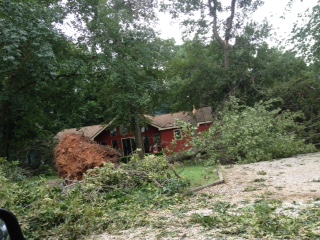
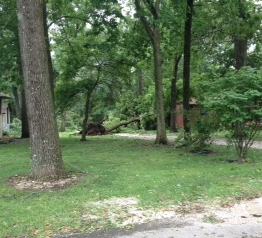
Severe wind and thunderstorms brought down several trees and uprooted many others in Sterett Creek on Wednesday night, July 1. (See photos below.) One road was blocked for a good part of the day by an uprooted and toppled tree whose thick trunk made passage impossible until a portion of its middle laying across the road, wide enough to allow one car at a time to pass through – very carefully – had been sawed out and removed.

Residents remembered a similar time when a storm – labeled a “microburst” – that hit in July 2012 left the Sterett Creek Marina turned over and several boats damaged or completely sunken.

Neighbors helped neighbors clear their properties and driveways by gathering broken tree limbs, loading and/or dragging them in golf carts to an open common area.

Meanwhile, Jessica Quick of abc17news.com reported the National Weather Service confirmed an EF-1 tornado about 3 miles northwest of Warsaw Wednesday night. It struck just minutes before 10 p.m. and caused uprooted trees, damage to a metal building and a boat dock, and sank several boats.

IMG_1074IMG_1072IMG_1066IMG_1075