Weather Patterns – Part One

Perspectives and laws on a number of issues, including global warming – now climate change, will take interesting turns after January 20, 2017. Indeed, president-elect Trump has held meetings already with Al Gore and Leonardo DiCaprio. Both are high-profile, heavy investors in climate change politics and business.

Therefore, to study national weather patterns is relevant, looking first to Missouri, home of the Enterprise.  Farmer’s Almanac website facilitates searches of daily temperatures by zip code, that the National Climatic Data Center has recorded since January 1, 1945.

According to the National Oceanic and Atmospheric Administration (NOAA) report, Climate in Missouri:

All of Missouri experiences “extreme” climate events and such events must be considered part of the normal climate (http://www.crh.noaa.gov/Image/dvn/downloads/Clim_MO_01.pdf).

Warsaw holds the record for the coldest temperature recorded in Missouri with -40°F on February 13, 1905. Along with Union, Mo., Warsaw also experienced the hottest recorded temperature of 118°F on July 14, 1954.

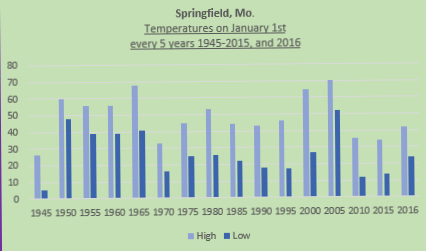
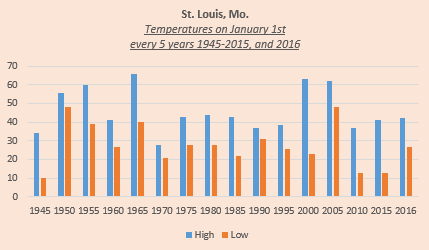
Because of their greater populations and the broader impacts of extreme events (albeit ‘normal’ for Missouri), data on three major cities on January 1st – St. Louis in east Missouri, Kansas City in the west, and Springfield in the south, is highlighted for this study.

Recall that in January 2006 Al Gore warned that global warming and greenhouse gases left unchecked would destroy the planet within a decade.

greenhouse-effect

Some consider his work suspect. January 22, 2016, Investors.com, published an article entitled: “Five Ways We Know Al Gore’s Been Running A Global Warming Racket.”  (http://www.investors.com/politics/editorials/al-gore-runs-global-warming-racket/).

Others proclaim that Gore has finally been taken seriously. Wired.com’s article on May 24, 2016 claimed: “10 Years After an Inconvenient Truth, Al Gore May Actually Be Winning”  (https://www.wired.com/2016/05/wired-al-gore-climate-change/).

Nevertheless, the charts below tell their own story, at least the part of it about changes over the past 16 years in this part of the country. Not only is the data between and among years useful for detecting trends over time, but the daily temperature changes between high and low are sometimes extreme.
temperature-charts

temperature-chart-2  temperature-chart-3

Part II will look at temperature records for the same time period on the East Coast; and Part III, on the West Coast.
Recreational Marijuana – No; Medical – Maybe

The Missouri Recreational Marijuana Legalization Initiative  will not be on the November 8, 2016 general election ballot. Petitioners failed to gather the required minimum number of signatures – 157,788, by the May 8, 2016 deadline.

Voter initiatives require a number of signatures equal to 8 percent of the votes cast in the most recent gubernatorial election. Signatures must be gathered from 6 of the 8 congressional districts with the choice of the districts left to the petitioners.

As a result of the failure to obtain enough signatures to put the recreational marijuana initiative on the ballot, Show-Me Cannabis supporters turned their efforts to an alternative, the Medical Marijuana Legalization Initiative.  More than 250,000 signatures were gathered and submitted to Missouri’s Secretary of State. Full text here.

No later than August 8, 2016 the secretary of state must determine the validity of the signatures which, if certified, would allow the proposal to be placed on the ballot.

In summary, Initiative 2016-135 (Ballotpedia.com) would amend the Missouri Constitution to:

  • allow the use of marijuana for medical purposes, and create regulations and licensing procedures for marijuana and marijuana facilities;
  • impose a 4 percent tax on the retail sale of marijuana; and
  • use funds from these taxes for health and care services for military veterans by the Missouri Veterans Commission and to administer the program to license and regulate marijuana and marijuana facilities?

This proposal is estimated to generate additional annual taxes and fees of $17 million to $21 million for state operating costs and veterans programs, $8 million for other state programs, and $7 million for local governments. State operating costs will be significant. Additional local government costs are likely.[2][3]

New initiatives to legalize marijuana for Arkansas (medical), California, Florida, Maine, Massachusetts and Montana (medical), have qualified to be on the respective states’ November 8 ballot. 

Alaska, Colorado, Oregon, Washington state and Washington, D.C. have legalized marijuana in previous elections.

Missouri driver’s licenses fail DHS test

As of Wednesday, January 13, Missouri driver’s licenses and identification cards (DL/ID) are no longer valid forms of identification for unescorted access to the military base at Fort Leonard Wood, Mo., according to information its Public Affairs Office issued earlier this week.

Valid secondary forms of ID required

Visitors needing emergency services will be allowed a one-time only pass using their Missouri DL/ID through January 27.

Thereafter, visitors must present additional valid ID such as a passport or a certified copy of birth certificate. (Contact the base for a complete list.)

Missouri law vs federal law

The procedural change results from failure to comply with all new criteria for driver’s licenses as specified in the REAL ID Act of 2005 (“the Act”).

Non-compliance deems Missouri’s driver’s licenses and ID cards unacceptable for identification purposes when accessing federal facilities (and nuclear power plants).

In fact, in April 2009, Missouri Governor Jay Nixon signed HB 361 into law to prohibit compliance with the Act.

Identity theft, biometrics, and citizens’ rights

Concerned citizens and lawmakers oppose collction of biometric data such as digital facial recognition images.

Others also, like the Constitutional Alliance , perceive the Act to be in violation of several constitutional rights. Because of its provisions for linking personal information databases nationwide, opponents fear the Act paves the way to a national identification system.

Proponents highlight the fact that several 9/11 terrorists used stolen, duplicate or fake driver’s licenses to board planes they crashed into the Twin Towers and the Pentagon, causing mass destruction of lives and property.

Missouri’s security enhancements fall short…

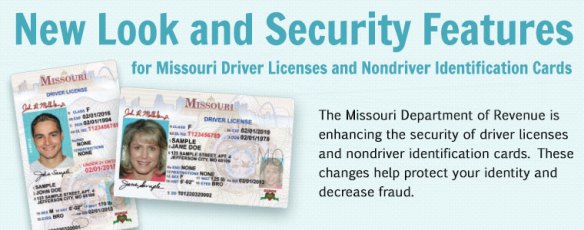
In December 2012, Department of Revenue (DOR) reformatted Missouri driver’s licenses and identification cards with security enhancements to protect against fraud and identity theft.

new-license-features

Processing was centralized and applicants no longer receive new licenses or cards over the counter. Rather, applicants now receive temporary papers good for 30 days while waiting an average of 7-10 days for their new licenses to arrive by mail.

Nevertheless, the Department of Homeland Security (DHS) notified officials in October 2015 that Missouri’s exemptions from implementing the Act would expire on January 10, 2016.

Greatest impact may come later…

In two years on January 22, 2018, Missouri travelers holding non-compliant DL/ID will face problems boarding domestic flights unless they can also present what the TSA deems an acceptable secondary form of identification.

Principle or pragmatism?

In light of the problems Missouri travelers would face in the future if nothing changes, Governor Nixon called for legislative action.

The House Committee on Emerging Issues scheduled a hearing for January 13 to discuss the Act and how best to preserve Missourians’ rights and interests.

Thanksgiving Proclamations

thanksgiving-2

President Barack Obama designated Thursday, November 26, 2015 this year as a National Day of Thanksgiving.

First proclaimed 226 years ago 

George Washington’s Thanksgiving Proclamation in October 1789 set aside the 26th of November that year for

…a day of public thanksgiving and prayer, to be observed by acknowledging with grateful hearts the many and signal favors of Almighty God, especially by affording them an opportunity peaceably to establish a form of government for their safety and happiness…

Missouri’s first Thanksgiving proclamation

Digital Heritage archives with the Missouri Secretary of State show that Governor Thomas Reynolds (1840-1844) issued the state’s first Thanksgiving Day proclamation. On October 16, 1843, he set aside the fourth Thursday in November.

[N.B.: Notwithstanding Reynolds’ many noteworthy accomplishments, the archive reveals that his life ended tragically.]

Every year since 1863

Exactly 74 years after Washington’s proclamation on October 3, 1863, President Abraham Lincoln issued his Thanksgiving Proclamation marking the last day of November

“… as a day of Thanksgiving and Praise to our beneficent Father who dwelleth in the Heavens…”

Bumps on the road to a federal holiday

In 1939 Thanksgiving Day would have fallen on the last day of November. That year, President Franklin Roosevelt proclaimed a change in date to the second to last Thursday in November.

The economy was in a recovery period and Roosevelt wanted to avoid stunting the turnaround by cutting short the Christmas shopping season.

Thirty-two states followed suit, but 16 refused to do so. For two years one group celebrated Thanksgiving on one day, and the other celebrated on another.

Finally…

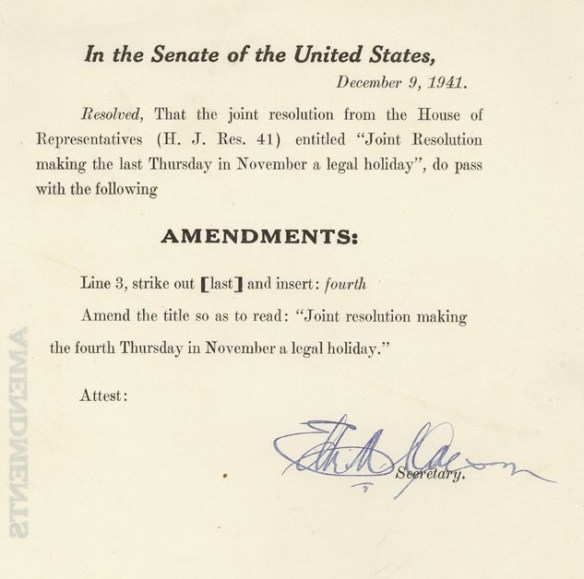
amendment-l

On December 26, 1941, Roosevelt signed the amended joint resolution proclaiming the fourth Thursday of November as Thanksgiving Day.