WHAT DO YOU KNOW AND HOW MUCH DO YOU CARE …

ABOUT CLIMATE CHANGE?

Please feel free to take part in the Survey linked below that seeks information about your interest in and concerns about climate change.

No personally identifiable information is collected or stored (i.e., your name, age, location, etc.). Completing the survey indicates informed consent. You may decide not to complete the survey at any time. There are 16 questions that should take 10 minutes or less to complete.

Thank you for considering the option to participate.

https://freeonlinesurveys.com/s/SftMky96

7 Days to Have a Say!

If you’ve been keeping up with what bureaucrats in your federal government departments are up to, you know from daily readings of the Federal Register what’s happening now!

Well, more accurately, you know some of what’s happening. In the last 7 days, 491 new public documents were created in the 16 departments. And, another 182 on which the public may comment have comment periods that close within 7 days, which is July 22, 2022.

The chart below depicts the distribution of new documents among the departments, and the additional numbers (orange) of documents for which public comments are due no later than July 22, 2022.

Transportation Department headed by Pete Buttigieg leads the pack with 75 new documents and 46 proposals. The general public, although entitled by Constitutional rights to participate in the Nation’s government, most likely have no idea about what is proposed, the impact on daily life, or the consequences of not participating.

As of 11:15 a.m. today, July 15, 2022, Special Filings include 11 documents from 11 agencies; 6 Notices; 2 Proposed Rules, and 3 Rules. Regular Filing as of 8:45 a.m. today, July 15, 2022, include
75 documents from 35 agencies; 57 Notices; 7 Proposed Rules, and 11 Rules.

What are the 14 new rules today about? Who is affected? What is the cost to taxpayers? WHO KNOWS?

Certainly it is too much for anyone to read the 491 documents received during the week ended July 15, and too much to research and comment on the 182 proposals whose comment period ends in one week.

Yet, for anyone interested in making the effort to have a say about one or a few, go to https://www.federalregister.gov/ and scroll down to “Explore Agencies” and click on the links to the particular department or to the numbers representing new documents or numbers open for public comment by July 22, 2022.

The scenario, and the process, continues daily.

H.R. 6666 – Introduced May 1, 2020

Apparently based on good intentions, certain provisions of this proposed legislation may deserve a May Day! May Day! call.

First, it states its general purpose:

The Secretary of Health and Human Services, acting through the Director of the Centers for Disease Control and Prevention, may award grants to eligible entities to conduct diagnostic testing for COVID–19…

but then rushes onto a what could become a slippery slope as to further intentions:

Happy International Men’s Day!

On behalf of all of us, male or female, who have loved and sometimes lost our beloved grandfathers, fathers, uncles, brothers, cousins, sons, friends, neighbors, mentors, bosses, pastors and innumerable service members – Cheers to all of you men, whatever color, creed, nationality, religion or other defining characteristic may be yours!

And, thank you for all you have been and are and will ever be to the rest of us!

Meanwhile, have a look and a read at the VitaCup Coffee website for an interesting and historical record of the celebration that is well deserved.

After all, a good man is like a good cup of coffee: strong, invigorating, a source of comfort and energy all at once, a pleasure to begin and end the day with – a wonderfully-made image of God!

DHL SCAM Alert

One recent attempt to scam the public is by an email message disguised as a DHL package tracking notice. Amateurish and poorly designed, even the least-experienced email and internet users should be able to discern its real nature.

DHL Scam_LI

Circled above is the true email sender’s address: mce.llado@agribioph.com, revealed by hovering the mouse over “DHL DELIVERY,” that at first glance appears to be the originator.

Several obvious indicators should raise suspicions. Notice the extra space between the words “sent” and “through” in the first sentence; fonts of various colors, sizes and styles, poor grammar, and the unprofessional look of the email overall.

A little research reveals that the “ph” in the sender’s email address represents a Philippine-sourced website that has earned at least 874 spam alerts. One source identified the site as one that infects the user’s computer device with a porn-based virus. The gullible and/or curious who click on the “Track your package” link within the email may be shocked when the DHL website is not what pops up!

After reporting these and emails like them as a phishing scheme, delete immediately.

As widespread and publicized as scams have become, it would seem fewer people fall victim to them. However, Jacob Passy, on March 10, 2018 in Market Watch online wrote that money lost to fraud increased by 7 percent in 2017. Further, contrary to the perception that seniors are more susceptible to fraud schemes than others, more millennials, 20 to 29 years old, lost money to scams in 2017 than senior citizens.

On June 8, 2018, David Pogue of Yahoo Finance, wrote about “9 Internet Scams We’re Still Falling for in 2018.” Two of the most often-repeated ways to avoid becoming a victim to scammers are: (1) do not click on any links within the message; and, (2) even when you recognize the company name as one you trust, be sure the sender is actually who it appears by going to the company’s website in a new and separate search.

The secure DHL package tracking website looks like this: Real DHL website


April is Keep America Beautiful Month

Since 1953 the Keep America Beautiful (KAB) Foundation works with partners and affiliates nationwide to fulfill its three-fold mission to End Littering, Improve Recycling and Beautify America’s Communities.

KAB’s Great American Cleanup program celebrates it 20th anniversary in 2018, and as the nation’s largest community improvement program, is active in approximately 20,000 communities. In 2017, nearly 5 million volunteers in those communities collected 186 million pounds of litter and debris.

This year, Dow Chemical Company and the Foundation will award $100,000 in grants to municipalities, nonprofits, materials recovery facilities and other qualifying organizations who apply by the June 15, 2018 deadline.

Access grant applications at https://www.kab.org/sites/default/files/program-resources/Hefty%20EnergyBag%20Grant%20Application.docx.

Dow will facilitate planning and implementation of Hefty® Energy Bag programs. The company will provide a blueprint for program development to grant recipients who will manage the programs locally with involvement from key community stakeholders.

Through these grants, plastics that cannot be recycled, such as chip bags and juice pouches, are diverted from landfills and converted into valuable energy resources.

Keep America Beautiful has “600 state and local affiliates, millions of volunteers, and the support of corporate partners, social and civic service organizations, academia, municipalities and government officials.”

To learn more about it, to become an affiliate, and to donate, go to kab.org, or FacebookInstagramTwitter and YouTube.

Affiliates include states like Georgia and Virginia, and cities like San Diego and Stamford, where projects range from planting trees and edibles, cleanups by kids and adults from 9 to 90, even recycling used bottle caps into works of art.

KAB’s resource page, https://www.kab.org/resources, includes youth resources, information and how-to’s on recycling, a model anti-littering ordinance, graffiti prevention guides for homeowners, businesses and a teacher’s guide as well as a report on how to create a community mural.

Keeping America beautiful is a privilege and responsibility that benefits when everyone participates in some way great or small, actively or by donating to the very worthy cause.

New Jail Proposition on April 2018 Ballot

Benton County voters will soon have opportunity to approve a proposal for construction of a long-awaited and desperately-needed new jail, or to reject it for a second time, keeping the status quo which for health, safety and security reasons is unacceptable.

The 162-year old building has been the subject of articles and conversations for the past several years. See https://readmyquips.wordpress.com/2014/11/) and search the print edition of the Benton County Enterprise for more information.

JailPhoto

Jailhouse2013 Photos by J.E. Coates

County Commissioners approved a motion on January 22, 2018 to place Proposition 1 on the April 2018 municipal election ballot.

Shall the County of Benton, Missouri impose a county wide sales tax in the amount of one-half of one percent ($0.005) for a period of twenty-one years from the date on which such tax is first imposed for purposes of operations and paying for construction of a new jail for detention facilities and administrative office space for the County Sheriff’s operations? If approved, this sales tax will expire on September 30, 2039 or whenever the final payment occurs on lease certificates of participation financing, whichever comes first.

If approved, after solicitation and acceptance of construction bids, the project, estimated to take 2-1/2 years to complete, would begin in Spring 2019.

The proposed site is on the access road across from the former Smoke Shack BBQ. It is close to the ambulance center, close to the water tower, has sewer and utility lines in place – saving an additional $1-2 million, and gives easy access to Hwy 65.

Sheriff Knox said the jail is “designed specifically for Benton County, based on information pulled from the jail project archives, and is exactly what the people asked for. The new plan saves nearly $5 million.  Much of the space is multifunctional, and unlike now, it is extremely secure.”

The design is state of the art, Knox said.  There are no razor wires. Inmates will be brought in via a secured sally port and will not be outside unless they have been released by the proper authorities and procedures.  No homes or children’s school or play areas are in the immediate vicinity; the jail will not be in anyone’s backyard.

Knox said everyone involved in the jail project has taken seriously the responsibility to be good stewards of taxpayer money. Geographically, site selection was limited because of the lakes, and because of the goal to save between $1-2 million by locating options with water, sewer and electricity already available. The difference between the site selected and the next best location about 100 yards south of it, was the price.

proposed jail

He respects opinions of residents who are  protesting the location, Knox said. He believes they do not yet have all the facts. Distribution of information about the jail project has begun, and opportunities to ask questions and learn more about the details will be available soon through townhall meetings.

On February 1st the sheriff posted a photo of the conceptual design on his Facebook page: https://facebook.com/SheriffKnox/ where more than 45 comments and 79 shares are supportive of the plan to date.


Small Business Victory

The National Federation of Independent Business (NFIB) is celebrating an important victory for small business: the August 31, 2017 permanent injunction ordered by U.S. District Court Judge Amos Mazzant against the Overtime Final Rule published by the Obama Administration’s Department of Labor (DOL) on May 23, 2016.

Under the rule, employees earning up to $47,000 annually, double the previous maximum, would be eligible for mandatory, time-and-a-half overtime pay for each hour worked over 40 hours per workweek.

According to the NFIB, at least 44% of small businesses would have incurred significant additional operating expense arising from more than 4 million additional workers who would have been eligible for the mandatory overtime pay.

The NFIB and several businesses filed a lawsuit that the district court combined with a separate suit brought by 21 states’ attorneys general against the new rule that was scheduled to take effect on December 1, 2016.

Implementation was blocked, however, by a temporary injunction ordered by Judge Mazzant of the Eastern District of Texas on November 22, 2016. The Obama Justice Department, on behalf of the Department of Labor (DOL), filed an appeal on December 1, 2016. The new administration filed a reply brief on June 30, 2017.  However, on August 31st:

The court held that the Final Rule’s salary level exceeded the Department’s authority, and concluded that the Final Rule is invalid.  The case was heard in the United States District Court, Eastern District of Texas, Sherman Division (State of Nevada, et al. v. United States Department of Labor, et al., No. 4:16-CV-00731). https://www.dol.gov/whd/overtime/final2016/litigation.htm

As the NFIB noted, the “government could appeal Judge Mazzant’s decision.”

Alternatively, as pointed out by MRA, a 501(c)6 non-profit trade association:

The DOL [under the Trump Administration] is focusing its efforts on further rulemaking. In fact, the DOL has recently issued a “request for information” (RFI) asking for public comment by September 25, 2017 on 11 particular questions.

Access the RFI here.

The NFIB website serves the small business community nationwide. NFIB Website

Coming Soon: The Great American Eclipse

On Monday, August 21, 2017 a solar eclipse will approach Oregon’s coast around 9 a.m. and reach totality by approximately 10:16 a.m., Pacific Time. The ‘Path of Totality’ arcs across the 48 states (CONUS), until approximately 5:04 p.m., Eastern Time.

Skies will darken along the Path that is 60 – 70 miles wide. Weather permitting and with essential protective eye gear, viewers close to the center line of the path will be able to watch as the orbiting moon travels between the earth and sun, completely blocking the sun’s image for about two minutes.

“The Great American Eclipse” is so named because the Path of Totality extends from the West to East Coasts. June 8, 1918, 99 years ago, was the last time a total eclipse was visible across the U.S. However, the rest of the world will see only a partial eclipse.

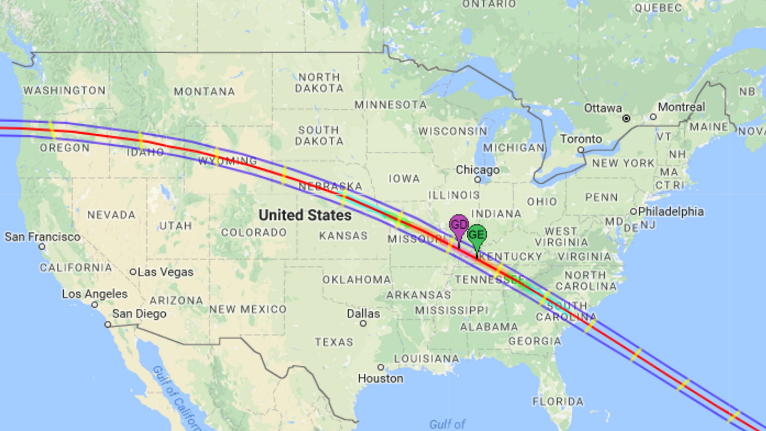
The Path shown below, from starting point to finish moves across Oregon, Idaho, Wyoming, Nebraska, Missouri, Illinois, Kentucky, Tennessee, Great Smokey Mountain National Park, and South Carolina.

The green “GE” indicates the greatest eclipse point just north of Hopkinsville, Kentucky at 36.97 N and 87.67 W. The red marker “GD” shows the greatest duration point – a few miles south of Carbondale, Illinois at 37.58 N and 89.11 W.

Five state capitals will experience totality: Salem, Oregon; Lincoln, Nebraska; Jefferson City, Missouri; Nashville, Tennessee, and Columbia, South Carolina.

St. Joseph, Missouri, on the center line of the Path, will have 2 min 39 sec of visibility; one of the places with the longest duration. A viewing party at the Rosecrans Memorial Airport is being organized. With speakers lined up and solar telescopes on site, viewers will have the ideal choice to be in the company of astronomers for the special event.

(See https://www.greatamericaneclipse.com/ for information about other eclipse-watching events and to shop for protective eyeglasses.)

Depending on the distance of their locations from the center line, viewers in areas beyond the 60-70 mile wide perimeter may have a partial view.

For example, Warsaw, Mo. is outside the totality path, able to view only a partial eclipse beginning at 11:43 a.m., and reaching maximum intensity at 1:12 p.m.

Jane J. Lee’s article for National Geographic on November 2, 2013, “Solar Eclipse Myths from Around the World,” included an informative 4-minute video (click on photo).

Solar Eclipse 101

North American eclipses occurring in the 21st century on April 8, 2024 and August 12, 2045 are among the several already mapped for enthusiasts and eclipse chasers at https://www.greatamericaneclipse.com/future.

Worldwide eclipses from 2011 through 2060 are mapped out as well; along with a link to a gallery of eclipses from 1651 to 2150.

Batting a Thousand!

A recent discovery that the bat colony inhabiting the attic of the county sheriff’s department numbers over one thousand has raised serious concerns about the health and safety of deputies working in the second-floor offices.

That bats are and have been hanging around in county buildings is not a surprise, but the nature and seriousness of health hazards posed by their multitudes was rather alarming.

Bats are not pretty, rather they seem creepy, in the eyes of most people. Nevertheless, members of the non-profit Missouri Bat Census and organizations like theirs are quite fond of, and concerned about bats, their safety and ensuring they are treated humanely.

bat_clip_art_18700

Generally speaking, however, anyone of mature years who remembers Count Dracula, or even the younger generation mesmerized by The Vampire Diaries or similar TV shows, may find it hard to resist associating all bats with the blood-sucking creatures of the night.

Yet in real life, bats, and specifically the 14-15 species found in Missouri, are protected under the Wildlife Code of Missouri. Some species are on the U.S. Fish and Wildlife endangered list, among them the gray bat and Indiana bat.

The Missouri Department of Conservation (MDC) views bats in very positive light, dispelling common myths about them: “These beneficial mammals consume tons of insects daily and some act as plant pollinators.” More than 400 products come from bat-pollinated plants, including bananas, avocados, cashews, balsa wood and tequila.

 Further, according to the MDC:

Bats are clean, shy and intelligent creatures. They occupy almost every habitat worldwide and are the primary predator of many insect pests that cause millions of dollars of damage to farms and forests annually.  

At the same time, the department acknowledges the health hazards imposed by a buildup of urine and feces.

Bats look like rodents but they are mammals, as noted above. Their young are born during the May-July time frame, and regulations preclude removing them from their habitat before the young are mature enough to exit their hideaways with the adults.

The recommended way to remove a bat or a few is to build an “exclusion” – a device that allows the bat to exit but prevents re-entry. Not recommended is to use fumigants or repellents, trapping or shooting the bats.

Unless it is damaging property, it is illegal to kill bats. Licensed wildlife (bat) removal services can be found online, operating out of Kansas City, St. Louis, and Springfield, Mo., among others.