Anecdotes in Life and Advertising

Anything happen to you lately, or even some time ago, that you’ve turned into a good story?

When telling about your experience, you’re sharing an anecdote – what Merriam-Webster defines as a “short story about an interesting or funny event.”

Sometimes there are stories heard from family members or friends that deserve to be passed on as well. A person doesn’t usually open the conversation by saying, “Here’s a little anecdote for you,” but that’s what it is.

TV ads use customers’ personal success stories about products or services. Who doesn’t know by now that Marie Osmond lost 50 pounds with Nutrisystem!

We can be pretty sure, however, that such “anecdotal evidence” (i.e., one person’s experience as proof for everyone) is not always trustworthy.

Study.com points out that other customers very often fail to get the same positive results claimed by one person who is often a celebrity. For that reason, advertisers insert disclaimers in the small print that is easily overlooked.

In the case of weight loss pills, for example, the whole story about people who lose significant weight while using a particular product may not be told. They may also change their diets and/or follow an exercise program but neglect to mention such facts.

Anecdotes are a part of everyday life and communication. They take many forms and serve many purposes.

Find more interesting stuff about anecdotes here.


13 Hours

13Hours

John Krasinski plays Jack DaSilva, one among those who “had the courage to do what was right” on September 11, 2012 when terrorists attacked the State Department and CIA compounds in Benghazi, Libya.

Krasinski believes with regret that the movie has become a political tool exploited by liberals and conservatives.

Foremost, he opined, it should be a tribute to the bravery of the six heroes, two of whom, Tyrone Woods and Glen Doherty, died, as did Ambassador J. Christopher Stevens and communications specialist, Sean Smith.

Can politics be separated from the story? That any one of them survived is a miracle; those six men stood and fought to protect American lives and property and stood and fought alone.

Had it been a story with made up heroes and villains, RPGs and shootouts, it could be dubbed a good movie by action film lovers.  But this is a real story about real people living amongst us in this day and time, and the “political” questions are unavoidable.

Why, in a failed state, in the midst of escalating tensions and recent departures of personnel from facilities of allies was there a drawdown rather than a buildup of security?

Where was the protection the Ambassador and Smith should have had from the local security force paid to guard the compound? Where was the help they should have had as soon as possible – and it would have been possible – from their fellow Americans, military or civilian?

It doesn’t seem right to call 13 Hours a “good movie.” Rather, it did a good job bringing the audience into the tensions, the emotions and the chaos that erupted that night. And, at times through tears.

The reality of political correctness, of reputation versus lives of fellow citizens – the realization that they were on their own, that help was not coming shocks the sensibilities.

You wonder – what would I do in such a situation where I had no help?

These men were heroes who had the stuff of heroes within them. Their only choice was whether to do nothing, or to put themselves out there no matter the cost.

God bless them, and RIP Stevens, Smith, Woods and Doherty.


FBI collects animal cruelty data

Persons guilty of animal cruelty are frequently involved in other criminal activity, and often, also commit violent crimes against humans.

In January 2015 the Federal Bureau of Investigation (FBI) began year-long preparations to collect data on these crimes.

The National Sheriffs’ Association (NSA) and the Animal Welfare Institute (AWI) worked in partnership with the FBI to implement the program.

Animal cruelty cases were previously included among “All Other Crimes” in the FBI’s Uniform Crime Report (UCR). Since 2014, however, animal cruelty is categorized as a Group A crime along with arson, assault and homicide.

AWI had lobbied the FBI for 12 years to make the change.

NIBRS

As of January 1, 2016 the FBI is adding acts of animal cruelty to its National Incident-Based Reporting System (NIBRS). The information will be available to the public in 2017.

NIBRS data will include incidents and arrests as required for four kinds of animal cruelty:

  • simple/gross neglect;
  • intentional abuse and torture;
  • organized abuse; and
  • animal sexual abuse.

The National Sheriff’s Association website highlights its National Law Enforcement Center on Animal Abuse.  The NLECAA serves to:

…bring greater awareness to, and understanding by, our nation’s law enforcement officers on the oftentimes misunderstood nature of animal abuse crimes and their link to violence against humans.

The Center provides information and training for officers to equip them for enforcing the animal abuse laws within their jurisdictions.

ICE_NSA_PhoneSmartphone app for reporting animal abuse

In addition, the NSA and the Humane Society of the United States launched a smartphone app for Apple and Android – available free to the public.

NSA Executive Director, John Thompson, said:

…we are using the latest in technology to help catch animal abusers in the act. We encourage everyone who has a smartphone and cares about protecting animals and our communities to download this new app.

Witnesses to animal abuse can make a video to submit to the NSA.  The Humane Society pays the costs to follow up on the case.  An agent will notify local authorities and animal services to retrieve the animal, and the district attorney to file charges.

Missouri laws on animal abuse

Chapter 578 of the Revised Missouri Statutes categorizes animal abuse under “Miscellaneous Offenses.” Changes that will take effect on January 1, 2017 are separately identified.

The Humane Society of Missouri operates an Animal Cruelty Task Force that serves 114 counties and the City of St. Louis.

The Task Force responds to disasters affecting animals, investigates reports of abuse, unlicensed puppy mills, pet hoarding, and mistreatment of farm animals.Animal Cruelty Hotline

Call the number on the banner to report abuse, or report incidents online here.


Missouri driver’s licenses fail DHS test

As of Wednesday, January 13, Missouri driver’s licenses and identification cards (DL/ID) are no longer valid forms of identification for unescorted access to the military base at Fort Leonard Wood, Mo., according to information its Public Affairs Office issued earlier this week.

Valid secondary forms of ID required

Visitors needing emergency services will be allowed a one-time only pass using their Missouri DL/ID through January 27.

Thereafter, visitors must present additional valid ID such as a passport or a certified copy of birth certificate. (Contact the base for a complete list.)

Missouri law vs federal law

The procedural change results from failure to comply with all new criteria for driver’s licenses as specified in the REAL ID Act of 2005 (“the Act”).

Non-compliance deems Missouri’s driver’s licenses and ID cards unacceptable for identification purposes when accessing federal facilities (and nuclear power plants).

In fact, in April 2009, Missouri Governor Jay Nixon signed HB 361 into law to prohibit compliance with the Act.

Identity theft, biometrics, and citizens’ rights

Concerned citizens and lawmakers oppose collction of biometric data such as digital facial recognition images.

Others also, like the Constitutional Alliance , perceive the Act to be in violation of several constitutional rights. Because of its provisions for linking personal information databases nationwide, opponents fear the Act paves the way to a national identification system.

Proponents highlight the fact that several 9/11 terrorists used stolen, duplicate or fake driver’s licenses to board planes they crashed into the Twin Towers and the Pentagon, causing mass destruction of lives and property.

Missouri’s security enhancements fall short…

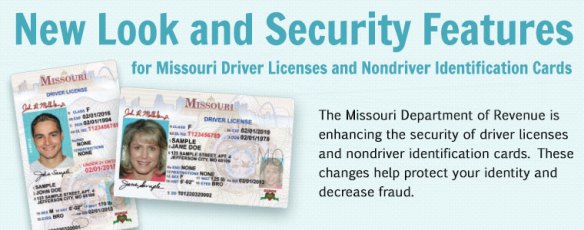
In December 2012, Department of Revenue (DOR) reformatted Missouri driver’s licenses and identification cards with security enhancements to protect against fraud and identity theft.

new-license-features

Processing was centralized and applicants no longer receive new licenses or cards over the counter. Rather, applicants now receive temporary papers good for 30 days while waiting an average of 7-10 days for their new licenses to arrive by mail.

Nevertheless, the Department of Homeland Security (DHS) notified officials in October 2015 that Missouri’s exemptions from implementing the Act would expire on January 10, 2016.

Greatest impact may come later…

In two years on January 22, 2018, Missouri travelers holding non-compliant DL/ID will face problems boarding domestic flights unless they can also present what the TSA deems an acceptable secondary form of identification.

Principle or pragmatism?

In light of the problems Missouri travelers would face in the future if nothing changes, Governor Nixon called for legislative action.

The House Committee on Emerging Issues scheduled a hearing for January 13 to discuss the Act and how best to preserve Missourians’ rights and interests.

Skip the resolutions!

Resources online may be more effective to make 2016 a happier, more productive year.

Pursuing happiness

Happiness is “a feeling or state of well-being and contentment,” according to Merriam-Webster Thesaurus that lists more than 40 words or phrases related to “happiness.”

Ellen Charry, a theology professor at Princeton, wrote

“Happiness … is enjoying a well-ordered life.”

The pursuit of happiness, along with life and liberty, is an inalienable right set out in America’s Declaration of Independence. But how should it be pursued?

A happy person is satisfied and content even when life is unsettled. Yet, many people exercise their “right” to pursue happiness through power, sex and money although they end up unsatisfied and discontent.

A few options and alternatives…

Being, or getting, happy

The conservative and non-partisan American Enterprise Institute in Washington, DC oversees a project website. ThePursuitofHappiness.com lists three goals:

  • Convene a new conversation;
  • Explore what the moral promise of pursuing happiness means in America today; and
  • Start a social movement to fulfill that promise.

Anyone who seeks personal happiness and ways to share it may find opportunities on the website.

thepursuitofhappiness

Happify.com

Happiness from a scientific perspective based on studies and experts, some of whom are psychologists, neuroscientists, family therapists and medical doctors.

Asserting that humans are naturally negative-minded, these experts claim our brains change with new thought patterns and simple exercises to overcome life stresses.

Happify Tracks

The exercises are part of several “tracks,” many of which can be accessed with the Free membership, and others, for willing participants, are available through paid subscriptions.

Happier.com

Founder and CEO, Nataly Kogan, presents five principles for happiness:

  • gratitude;
  • happy friends and acquaintances;
  • doing nice things for others;
  • spending time with family and friends, and
  • spending money on experiences, not material things.

Kogan offers a mobile app for a variety of mostly-free courses that can also be accessed on a personal computer.

Fans of Deepak Chopra can access courses taught by him, including one titled “Super Brain.”

Happier

Toward a well-ordered life…

Mark Joyner created Simpleology and wrote a book with the title. The website offers a “Start My Day” management tool as well as several legacy courses and a blog.

An introductory course titled, Simpleology 101: The Simple Science of Getting What You Want is one of six core courses teaching on the mind and on money.

Simpleology HomePage.jpg

The screen shot below shows the pop-up for signing up for the free “Simpleology LITE” program. Simply click on it!

Simpleology LITE home page

GTD

Another website with a different approach to increasing personal and/or corporate productivity is gettingsthingsdone.com, by author and consultant David Allen.

Based on the premise that “Your mind is for having ideas, not holding them,” Allen offers insights, courses, coaching and a 14-day free trial for access to everything.

gtd home page

A systematic approach

Forbes reports that only 8 percent of people fulfill their resolutions. One common reason why is the lack of a systematic approach.

One or more of the online programs above that actually do provide a systematic approach may be worth looking into.

Sincere but vague new year resolutions are ineffective for people who are serious about doing what it takes to increase their levels of happiness and productivity in 2016.


(Disclaimer: Websites highlighted herein are provided for information only and not as endorsements by the author or Benton County Enterprise.)


Today, the future…

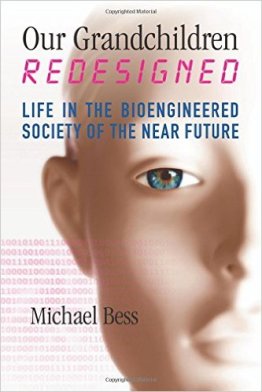
cover Our GrandchildrenOur Grandchildren Redesigned evokes many OMG! moments.

Author Michael Bess writes in his introduction, “Welcome to the Future,” about human enhancements coming via technological changes, saying

…it is not our gadgets that will be transformed—it is we ourselves, our bodies, our minds…[for] …direct and precise control over our own physical and mental states…

Whoa!

Bess’s comprehensive research and analysis is evident in the more than 65 pages of references and a 13-page index.

The author concludes by exhorting everyone concerned to adopt an attitude of humility about technological advances and how they are incorporated into daily life. He opines that

…The merest act of kindness will still remain the Ultimate Enhancement.

Bess presupposes evolution and climate change. Societal changes are inevitable and will result from a multitude of new options for enhancements of the human body and mind.

Experiments ongoing for decades are broadening and increasing at an accelerated rate.

The effects on human souls and spirits of altered DNA and bio-engineering are matters for long and careful thought and reflection.

Those who believe morality and “being” fall under the jurisdiction of an Almighty God and Creator may attribute the quest for “enhanced” human existence to lust, pride of life and to hunger for power.

On the other hand, Bess reminds of medications and pharmaceuticals such as Prozac and Viagra in wide use and acceptance today – precursors of more fantastic things to come.

Bess earns high marks for his book whether readers agree and will support, or disagree and will resist the ongoing pursuit for a superhuman that he writes about.

Our Grandchildren Redesigned is well written, comprehensive, instructional, educational, and certainly eye-opening.

There is much for readers to consume, and it is best digested slowly and deliberately.

For old times’ sake…

Scotland.org refers to Auld Lang Syne as

… one of Scotland’s gifts to the world, recalling the love and kindness of days gone by, but in the communion of taking our neighbors’ hands, it also gives us a sense of belonging and fellowship to take into the future.

Robert Burns

Scotland’s national poet, Robert Burns collected portions of old lyrics and in 1788 created one of the most famous poems ever set to music.

As part of Burns’ collection, Wikipedia.org refers to the first verse and chorus of “Old Long Syne,” a ballad James Watson wrote in 1711.

Because it is quite similar to Burns’ finished product it is very likely both originated from the same old song.

From Scotland to the world

Singing Auld Lang Syne as the clock strikes 12 at midnight on New Year’s Eve, or Hogmanay, is a tradition that has spread from Scotland to the English-speaking world, and beyond.

How to sing Auld Lang Syne

Create a circle and join hands with the person on each side.

At the beginning of the last verse, everyone crosses their arms across their breast, so that the right hand reaches out to the neighbor on the left and vice versa. When the tune ends, everyone rushes to the middle, while still holding hands.

Burns Night

Every year on January 25 Scotland celebrates the life of Robert Burns with special food and drink and singing of Auld Lang Syne.

Checking out charities

checkbook and pen

Charities solicit donations throughout the year, yet year-end giving is an important and special source of income for most.

A generous spirit motivates many people during the holidays. Tax deductions motivate people, too.mailbox

Nevertheless, they want their limited and hard-earned dollars to go to causes they believe in.

Mailboxes get crammed with calendars, address labels, notepads, dream catchers and year-end membership renewal letters.

Deciding how much to give to which deserving charity or charities can be difficult.

For example…

Defenders of Wildlife is rather well known. Beautifully-photographed wildlife calendars enhance its fundraising campaigns. Solicitation letters cite case studies and statistics about endangered animals in appeals for donations.

Defenders’ stated purpose is: “to protect all native animals and plants in their natural communities.”

However, it spends more than 28 percent of its income on climate change and federal environmental protection causes.  Some donors may acknowledge and heartily support Defenders’ political activism.

Other donors and potential contributors may be unaware that Defenders of Wildlife pursues and funds a dual agenda. Whether they support one or another program, donors want to have all the available information.

Sources for checking out charities

Three widely recognized charity raters are BBB Wise Giving Alliance, Charity Navigator, and Guide Star.

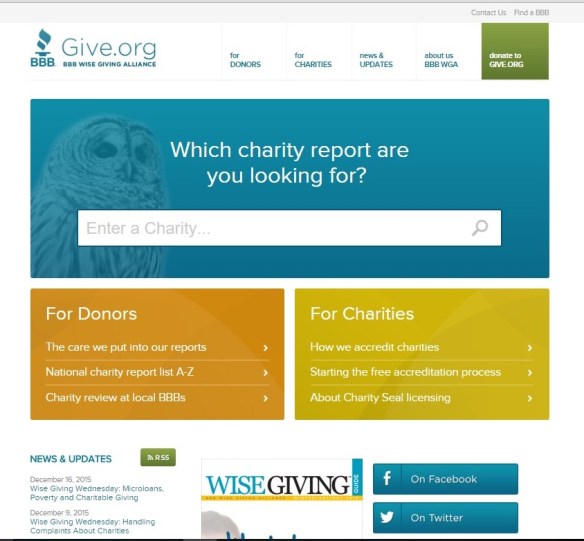
  • The BBB Wise Giving Alliance (WGA) evaluates charities that request it, or when a member of the public makes an inquiry. WGA also publishes a Wise Giving Guide three times a year.

BBBGiveorg

  • Charity Navigator rates 8,000 charities, calculating the average of their financial health and accountability and transparency scores, up to a maximum 100 points that earns them from one to four stars.
  • It also maintains a Donor Advisory and a Watch list of charities with legal or other problems or issues that donors should know about.

CharityNavigatorHomePg

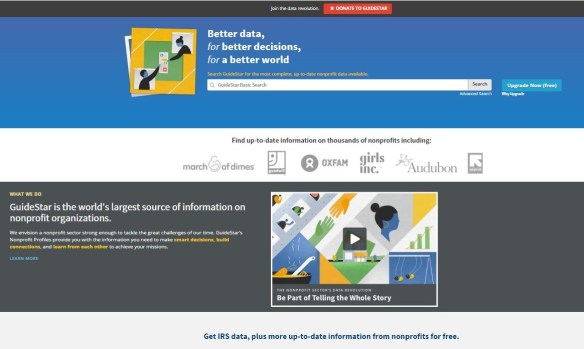
  • Guide Star reports on the largest number of non-profits – more than 1.8 million.

GuideStar home page

Continue reading

‘Tis the season…

Several local establishments got a very merry surprise on Wednesday when Benton County’s own 4 HIM Quartet visited them to share much-needed Christmas cheer.

Integrated-Fitness (950 E. Main St.) was among the fortunate hosts, and wants to share the experience with readers by means of the short video below.

Listen and enjoy excerpts from the medley of Christian and popular seasonal tunes performed by four talented women who harmonize so beautifully – A Capella.

4 HIM will perform this Saturday, December 12, 2015 between 5:30 and 7:30 p.m. in the Chapel of Powell Gardens:   

 816-697-2600

1609 N.W. U.S. Highway 50

Kingsville, MO 64061

Info@PowellGardens.org 

The quartet is part of the larger Show Me Sound Chorus performing at the annual event that includes a men’s chorus as well.


Christmas, and Trees

A Missouri Botanical Garden fact sheet on “Selection and Care of Christmas Trees” opens with a brief history about the first time Christmas was celebrated on December 25.

First recorded Christmas

Dan Graves writing in June 2007 for Christianity.com confirmed the information was found on a note from an old list of Roman bishops.  Translated from Latin to English it says: “December 25th, Christ born in Bethlehem, Judea.”

As to how that date was established, Ted Olsen wrote in the March 2010 edition of Christianity.com about historian William J. Tighe’s research.

  • Tighe noted a belief in Judaism that prophets died on the same day of the month they had been conceived.
  • Latin Christians (West) accepting that Jesus died — and thus would have been conceived on March 25, celebrate Christmas on December 25, the prevailing practice.
  • Greek Christians (East) accepting that Jesus died — and thus would have been conceived on April 6, celebrate his birth nine months later on January 6.

Pro-life and the Annunciation

With historical emphasis on conception, no wonder Olsen questioned why pro-life evangelical Protestants associate Christ’s conception in Mary’s womb – the Incarnation, more with his birth into the world at Christmas than with the Annunciation.

No Christmas!

Perhaps surprising to many there was a time when Christmas was banned, in England until 1660:

… during the sixteenth and seventeenth century by Puritans … who believed that people needed strict rules to be religious and that any kind of merrymaking was sinful.

Mince PiesAnd Christmas was illegal in Boston from 1659 to 1681, as were mince pies and pudding.

Back to the trees…

Scotch pine and Douglas fir are the most popular Christmas trees in the country overall. In Missouri the most popular are the Scotch pine and the Eastern white pine, the latter being the second tallest pine tree in the U.S.

For more information check out the Missouri Botanical Fact Sheet.