A new jail for Benton County, Mo. (?)

This writer first highlighted the sorry state of the Benton County, Mo. jail in November 2014 in another [currently inactive] blogsite (that may someday be revived).

The article, including photos taken at the time: History is Rich, Conditions are Poor at Benton County, Mo. Jail, can be read here.

Now, several months later with conditions even worse, Benton County voters have opportunity to approve new but nominal sales taxes — one-half cent for construction and one-eighth cent for maintenance and upkeep.

Benton County presents its case to the public in the brochure below, reformatted for this article. Copies are available at the County Courthouse, the Chamber of Commerce and several local area places of business.Jail 2

Jail 1

Most important is for registered voters to read, ask the contacts named above any questions that arise, consider the options and alternatives, and vote on April 5, 2016!


FBI collects animal cruelty data

Persons guilty of animal cruelty are frequently involved in other criminal activity, and often, also commit violent crimes against humans.

In January 2015 the Federal Bureau of Investigation (FBI) began year-long preparations to collect data on these crimes.

The National Sheriffs’ Association (NSA) and the Animal Welfare Institute (AWI) worked in partnership with the FBI to implement the program.

Animal cruelty cases were previously included among “All Other Crimes” in the FBI’s Uniform Crime Report (UCR). Since 2014, however, animal cruelty is categorized as a Group A crime along with arson, assault and homicide.

AWI had lobbied the FBI for 12 years to make the change.

NIBRS

As of January 1, 2016 the FBI is adding acts of animal cruelty to its National Incident-Based Reporting System (NIBRS). The information will be available to the public in 2017.

NIBRS data will include incidents and arrests as required for four kinds of animal cruelty:

  • simple/gross neglect;
  • intentional abuse and torture;
  • organized abuse; and
  • animal sexual abuse.

The National Sheriff’s Association website highlights its National Law Enforcement Center on Animal Abuse.  The NLECAA serves to:

…bring greater awareness to, and understanding by, our nation’s law enforcement officers on the oftentimes misunderstood nature of animal abuse crimes and their link to violence against humans.

The Center provides information and training for officers to equip them for enforcing the animal abuse laws within their jurisdictions.

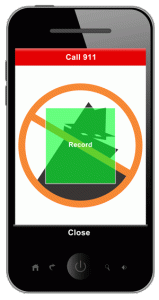
ICE_NSA_PhoneSmartphone app for reporting animal abuse

In addition, the NSA and the Humane Society of the United States launched a smartphone app for Apple and Android – available free to the public.

NSA Executive Director, John Thompson, said:

…we are using the latest in technology to help catch animal abusers in the act. We encourage everyone who has a smartphone and cares about protecting animals and our communities to download this new app.

Witnesses to animal abuse can make a video to submit to the NSA.  The Humane Society pays the costs to follow up on the case.  An agent will notify local authorities and animal services to retrieve the animal, and the district attorney to file charges.

Missouri laws on animal abuse

Chapter 578 of the Revised Missouri Statutes categorizes animal abuse under “Miscellaneous Offenses.” Changes that will take effect on January 1, 2017 are separately identified.

The Humane Society of Missouri operates an Animal Cruelty Task Force that serves 114 counties and the City of St. Louis.

The Task Force responds to disasters affecting animals, investigates reports of abuse, unlicensed puppy mills, pet hoarding, and mistreatment of farm animals.Animal Cruelty Hotline

Call the number on the banner to report abuse, or report incidents online here.


Missouri driver’s licenses fail DHS test

As of Wednesday, January 13, Missouri driver’s licenses and identification cards (DL/ID) are no longer valid forms of identification for unescorted access to the military base at Fort Leonard Wood, Mo., according to information its Public Affairs Office issued earlier this week.

Valid secondary forms of ID required

Visitors needing emergency services will be allowed a one-time only pass using their Missouri DL/ID through January 27.

Thereafter, visitors must present additional valid ID such as a passport or a certified copy of birth certificate. (Contact the base for a complete list.)

Missouri law vs federal law

The procedural change results from failure to comply with all new criteria for driver’s licenses as specified in the REAL ID Act of 2005 (“the Act”).

Non-compliance deems Missouri’s driver’s licenses and ID cards unacceptable for identification purposes when accessing federal facilities (and nuclear power plants).

In fact, in April 2009, Missouri Governor Jay Nixon signed HB 361 into law to prohibit compliance with the Act.

Identity theft, biometrics, and citizens’ rights

Concerned citizens and lawmakers oppose collction of biometric data such as digital facial recognition images.

Others also, like the Constitutional Alliance , perceive the Act to be in violation of several constitutional rights. Because of its provisions for linking personal information databases nationwide, opponents fear the Act paves the way to a national identification system.

Proponents highlight the fact that several 9/11 terrorists used stolen, duplicate or fake driver’s licenses to board planes they crashed into the Twin Towers and the Pentagon, causing mass destruction of lives and property.

Missouri’s security enhancements fall short…

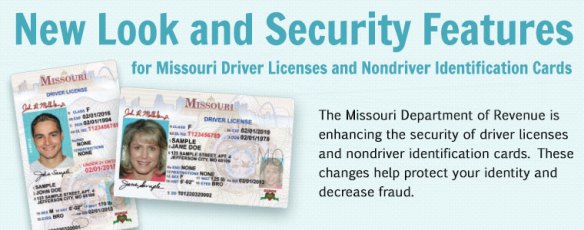
In December 2012, Department of Revenue (DOR) reformatted Missouri driver’s licenses and identification cards with security enhancements to protect against fraud and identity theft.
new-license-features

Processing was centralized and applicants no longer receive new licenses or cards over the counter. Rather, applicants now receive temporary papers good for 30 days while waiting an average of 7-10 days for their new licenses to arrive by mail.

Nevertheless, the Department of Homeland Security (DHS) notified officials in October 2015 that Missouri’s exemptions from implementing the Act would expire on January 10, 2016.

Greatest impact may come later…

In two years on January 22, 2018, Missouri travelers holding non-compliant DL/ID will face problems boarding domestic flights unless they can also present what the TSA deems an acceptable secondary form of identification.

Principle or pragmatism?

In light of the problems Missouri travelers would face in the future if nothing changes, Governor Nixon called for legislative action.

The House Committee on Emerging Issues scheduled a hearing for January 13 to discuss the Act and how best to preserve Missourians’ rights and interests.