For old times’ sake…

Scotland.org refers to Auld Lang Syne as

… one of Scotland’s gifts to the world, recalling the love and kindness of days gone by, but in the communion of taking our neighbors’ hands, it also gives us a sense of belonging and fellowship to take into the future.

Robert Burns

Scotland’s national poet, Robert Burns collected portions of old lyrics and in 1788 created one of the most famous poems ever set to music.

As part of Burns’ collection, Wikipedia.org refers to the first verse and chorus of “Old Long Syne,” a ballad James Watson wrote in 1711.

Because it is quite similar to Burns’ finished product it is very likely both originated from the same old song.

From Scotland to the world

Singing Auld Lang Syne as the clock strikes 12 at midnight on New Year’s Eve, or Hogmanay, is a tradition that has spread from Scotland to the English-speaking world, and beyond.

How to sing Auld Lang Syne

Create a circle and join hands with the person on each side.

At the beginning of the last verse, everyone crosses their arms across their breast, so that the right hand reaches out to the neighbor on the left and vice versa. When the tune ends, everyone rushes to the middle, while still holding hands.

Burns Night

Every year on January 25 Scotland celebrates the life of Robert Burns with special food and drink and singing of Auld Lang Syne.

‘Tis the season…

Several local establishments got a very merry surprise on Wednesday when Benton County’s own 4 HIM Quartet visited them to share much-needed Christmas cheer.

Integrated-Fitness (950 E. Main St.) was among the fortunate hosts, and wants to share the experience with readers by means of the short video below.

Listen and enjoy excerpts from the medley of Christian and popular seasonal tunes performed by four talented women who harmonize so beautifully – A Capella.

4 HIM will perform this Saturday, December 12, 2015 between 5:30 and 7:30 p.m. in the Chapel of Powell Gardens:   

 816-697-2600

1609 N.W. U.S. Highway 50

Kingsville, MO 64061

Info@PowellGardens.org 

The quartet is part of the larger Show Me Sound Chorus performing at the annual event that includes a men’s chorus as well.


Christmas, and Trees

A Missouri Botanical Garden fact sheet on “Selection and Care of Christmas Trees” opens with a brief history about the first time Christmas was celebrated on December 25.

First recorded Christmas

Dan Graves writing in June 2007 for Christianity.com confirmed the information was found on a note from an old list of Roman bishops.  Translated from Latin to English it says: “December 25th, Christ born in Bethlehem, Judea.”

As to how that date was established, Ted Olsen wrote in the March 2010 edition of Christianity.com about historian William J. Tighe’s research.

  • Tighe noted a belief in Judaism that prophets died on the same day of the month they had been conceived.
  • Latin Christians (West) accepting that Jesus died — and thus would have been conceived on March 25, celebrate Christmas on December 25, the prevailing practice.
  • Greek Christians (East) accepting that Jesus died — and thus would have been conceived on April 6, celebrate his birth nine months later on January 6.

Pro-life and the Annunciation

With historical emphasis on conception, no wonder Olsen questioned why pro-life evangelical Protestants associate Christ’s conception in Mary’s womb – the Incarnation, more with his birth into the world at Christmas than with the Annunciation.

No Christmas!

Perhaps surprising to many there was a time when Christmas was banned, in England until 1660:

… during the sixteenth and seventeenth century by Puritans … who believed that people needed strict rules to be religious and that any kind of merrymaking was sinful.

Mince PiesAnd Christmas was illegal in Boston from 1659 to 1681, as were mince pies and pudding.

Back to the trees…

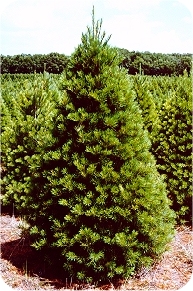
Scotch pine and Douglas fir are the most popular Christmas trees in the country overall. In Missouri the most popular are the Scotch pine and the Eastern white pine, the latter being the second tallest pine tree in the U.S.

For more information check out the Missouri Botanical Fact Sheet.

Advent 2015

Advent wreathLicensed under Creative Commons

The candles symbolize the coming of Christ,  and traditionally, one is lit the first Sunday before Christmas and the two Sundays following. The fourth candle is lit either on Christmas Eve or on Christmas Day.

The Lutheran Church Missouri Synod’s  Church-Year document explains that three purple candles represent the royalty of Christ, and a pink candle – lit on the third Sunday in Advent, represents the joy of His coming.

The United Methodist Church celebrates on each Sunday in Advent one of the four virtues of Christ: Hope, Love, Joy and Peace. Some churches use four purple candles for the four weeks of Advent, and a fifth white candle in the center – the “Christ candle.”

The Catholic Education Resource Center (CERG) website offers a history of Advent as well, noting the evergreen wreath symbolizes continuous life, and the candles represent the light, which is Christ.

Thanksgiving Proclamations

thanksgiving-2

President Barack Obama designated Thursday, November 26, 2015 this year as a National Day of Thanksgiving.

First proclaimed 226 years ago 

George Washington’s Thanksgiving Proclamation in October 1789 set aside the 26th of November that year for

…a day of public thanksgiving and prayer, to be observed by acknowledging with grateful hearts the many and signal favors of Almighty God, especially by affording them an opportunity peaceably to establish a form of government for their safety and happiness…

Missouri’s first Thanksgiving proclamation

Digital Heritage archives with the Missouri Secretary of State show that Governor Thomas Reynolds (1840-1844) issued the state’s first Thanksgiving Day proclamation. On October 16, 1843, he set aside the fourth Thursday in November.

[N.B.: Notwithstanding Reynolds’ many noteworthy accomplishments, the archive reveals that his life ended tragically.]

Every year since 1863

Exactly 74 years after Washington’s proclamation on October 3, 1863, President Abraham Lincoln issued his Thanksgiving Proclamation marking the last day of November

“… as a day of Thanksgiving and Praise to our beneficent Father who dwelleth in the Heavens…”

Bumps on the road to a federal holiday

In 1939 Thanksgiving Day would have fallen on the last day of November. That year, President Franklin Roosevelt proclaimed a change in date to the second to last Thursday in November.

The economy was in a recovery period and Roosevelt wanted to avoid stunting the turnaround by cutting short the Christmas shopping season.

Thirty-two states followed suit, but 16 refused to do so. For two years one group celebrated Thanksgiving on one day, and the other celebrated on another.

Finally…

amendment-l

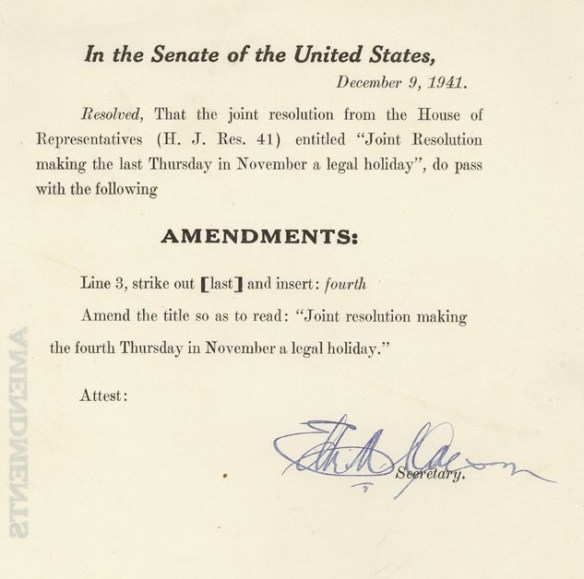
On December 26, 1941, Roosevelt signed the amended joint resolution proclaiming the fourth Thursday of November as Thanksgiving Day.