January 20, 2017 and the Next 100 Days

NPR  on November 9 published promises the then future President-Elect Donald Trump made to America during his speech in Gettysburg, Pa. in late October this year.

Trump said he will:

FIRST, propose a Constitutional Amendment to impose term limits on all members of Congress;
 SECOND, a hiring freeze on all federal employees to reduce federal workforce through attrition (exempting military, public safety, and public health);
 THIRD, a requirement that for every new federal regulation, two existing regulations must be eliminated;
 FOURTH, a 5 year-ban on White House and Congressional officials becoming lobbyists after they leave government service;
 FIFTH, a lifetime ban on White House officials lobbying on behalf of a foreign government;
 SIXTH, a complete ban on foreign lobbyists raising money for American elections.
  • On the same day, (I will) begin taking the following 7 actions to protect American workers:
FIRST, I will announce my intention to renegotiate NAFTA or withdraw from the deal under Article 2205
SECOND, I will announce our withdrawal from the Trans-Pacific Partnership
 THIRD, I will direct my Secretary of the Treasury to label China a currency manipulator
 FOURTH, I will direct the Secretary of Commerce and U.S. Trade Representative to identify all foreign trading abuses that unfairly impact American workers and direct them to use every tool under American and international law to end those abuses immediately
 FIFTH, I will lift the restrictions on the production of $50 trillion dollars’ worth of job-producing American energy reserves, including shale, oil, natural gas and clean coal.
 SIXTH, lift the Obama-Clinton roadblocks and allow vital energy infrastructure projects, like the Keystone Pipeline, to move forward
 SEVENTH, cancel billions in payments to U.N. climate change programs and use the money to fix America’s water and environmental infrastructure
  • Additionally, on the first day, (I will) take the following five actions to restore security and the constitutional rule of law:
FIRST, cancel every unconstitutional executive action, memorandum and order issued by President Obama
SECOND, begin the process of selecting a replacement for Justice Scalia from one of the 20 judges on my list, who will uphold and defend the Constitution of the United States
THIRD, cancel all federal funding to Sanctuary Cities
FOURTH, begin removing the more than 2 million criminal illegal immigrants from the country and cancel visas to foreign countries that won’t take them back
FIFTH, suspend immigration from terror-prone regions where vetting cannot safely occur. All vetting of people coming into our country will be considered extreme vetting.
  • Next, (I will) work with Congress to introduce the following broader legislative measures and fight for their passage within the first 100 days of (my) Administration:
  1. Middle Class Tax Relief and Simplification Act. An economic plan designed to grow the economy 4% per year and create at least 25 million new jobs through massive tax reduction and simplification, in combination with trade reform, regulatory relief, and lifting the restrictions on American energy. The largest tax reductions are for the middle class. A middle-class family with 2 children will get a 35% tax cut. The current number of brackets will be reduced from 7 to 3, and tax forms will likewise be greatly simplified. The business rate will be lowered from 35 to 15 percent, and the trillions of dollars of American corporate money overseas can now be brought back at a 10 percent rate.
  2. End The Offshoring Act. Establishes tariffs to discourage companies from laying off their workers in order to relocate in other countries and ship their products back to the U.S. tax-free.
  3. American Energy & Infrastructure Act. Leverages public-private partnerships, and private investments through tax incentives, to spur $1 trillion in infrastructure investment over 10 years. It is revenue neutral.
  4. School Choice and Education Opportunity Act. Redirects education dollars to give parents the right to send their kid to the public, private, charter, magnet, religious or home school of their choice. Ends common core, brings education supervision to local communities. It expands vocational and technical education, and make 2 and 4-year college more affordable.
  5. Repeal and Replace Obamacare Act. Fully repeals Obamacare and replaces it with Health Savings Accounts, the ability to purchase health insurance across state lines, and lets states manage Medicaid funds. Reforms will also include cutting the red tape at the FDA: there are over 4,000 drugs awaiting approval, and we especially want to speed the approval of life-saving medications.
  6. Affordable Childcare and Eldercare Act. Allows Americans to deduct childcare and elder care from their taxes, incentivizes employers to provide on-side childcare services, and creates tax-free Dependent Care Savings Accounts for both young and elderly dependents, with matching contributions for low-income families.
  7. End Illegal Immigration Act.  Fully-funds the construction of a wall on our southern border with the full understanding that the country Mexico will be reimbursing the United States for the full cost of such wall; establishes a 2-year mandatory minimum federal prison sentence for illegally re-entering the U.S. after a previous deportation, and a 5-year mandatory minimum for illegally re-entering for those with felony convictions, multiple misdemeanor convictions or two or more prior deportations; also reforms visa rules to enhance penalties for overstaying and to ensure open jobs are offered to American workers first.
  8. Restoring Community Safety Act. Reduces surging crime, drugs and violence by creating a Task Force On Violent Crime and increasing funding for programs that train and assist local police; increases resources for federal law enforcement agencies and federal prosecutors to dismantle criminal gangs and put violent offenders behind bars.
  9. Restoring National Security Act. Rebuilds our military by eliminating the defense sequester and expanding military investment; provides Veterans with the ability to receive public VA treatment or attend the private doctor of their choice; protects our vital infrastructure from cyber-attack; establishes new screening procedures for immigration to ensure those who are admitted to our country support our people and our values
  10. Clean up Corruption in Washington Act. Enacts new ethics reforms to Drain the Swamp and reduce the corrupting influence of special interests on our politics.
Liberty and the Pursuit of Happiness, but Life is not Guaranteed

The Hyde Amendment, in effect with bipartisan support since 1976, prohibits payments for abortions from federal funds, specifically, from Medicaid.

Democratic presidential candidate Hillary Clinton wants it repealed, if she is elected.

The 2016 Democratic Platform states in part, on page 37:

We believe unequivocally, like the majority of Americans, that every woman should have access to quality reproductive health care services, including safe and legal abortion—regardless of where she lives, how much money she makes, or how she is insured.  … We will continue to oppose—and seek to overturn—federal and state laws and policies that impede a woman’s access to abortion, including by repealing the Hyde Amendment…

 The goal of conservative Republicans on the other hand is to pass an amendment to the Constitution confirming that life begins at conception.

The 2016 Republican Platform states in part, on page 17:

… We support a human life amendment to the Constitution and legislation to make clear that the Fourteenth Amendment’s protections apply to children before birth. We oppose the use of public funds to perform or promote abortion or to fund organizations, like Planned Parenthood, so long as they provide or refer for elective abortions or sell fetal body parts rather than provide healthcare.

 Supreme Court Justice Henry Blackmun wrote in the 1973 Roe vs Wade decision that the court was not speculating to resolve the question of when life begins; however, if the “personhood” of a fetus were established, then protection of its right to life under the 14th Amendment would be guaranteed.

Missouri Republicans recently proposed a personhood bill that was widely opposed by Democrats. The bill, HJR 98, has little hope of passage, at least in the near-term.

However, Governor Nixon did sign the “Strengthening Missouri Families Act” in 2015 that allocates $4.3 million for alternatives to abortion, including grants to crisis pregnancy centers in the state, religious organizations and adoption agencies. This amount was an increase over the previous $2 million.

“Abortion” and “fetus” are terms widely used. Inserting their origins and definitions into the narrative can give another perspective beyond clinical terms that diminish the reality of the life and death issues involved.

Merriam-Webster Dictionary’s “simple definition” of “abort” is: “to end a pregnancy deliberately by causing the death of the fetus.”

The Online Etymology Dictionary [of origins and meanings] defines the Latin term “fetus” as: “the young while in the womb or egg …, the bearing or hatching of young, a bringing forth.”  Curiously, the common understanding of the word ‘fetus as advanced by the pro-choice lobby is as “a simple glob of cells” – something more akin to a tumor, and it follows that “abortion” is often glibly understood simply to mean the removal of an unwanted growth.

Defining the terms used in the Democratic Party platform quoted above would clarify them, if written as follows:

We believe unequivocally that every woman should have access to quality reproductive health care services, including safe and legal [means] to cause the death of the young in the womb or egg… We will continue to oppose—and seek to overturn—federal and state laws and policies that impede a woman’s access to [means] to cause the death of the young in the womb or egg, including by repealing the Hyde Amendment…

 Guttmacher Institute (GI) that lobbies for expanded abortion rights, the Center for Disease Control (CDC), and the U.S. Census Bureau (USCB) are sources of the statistics reported herein.

The Hyde Amendment, according to Guttmacher, prevents access to insurance coverage for abortions to seven million women between the ages of 15-44 enrolled in Medicaid as of 2014. Among them, 52 percent are black or Hispanic, the other 48 percent White.

Pro-life proponents interpret the Preamble to the U.S. Constitution on securing “the Blessings of Liberty to ourselves and our Posterity,” where “posterity” refers to future generations of offspring, to offer protection to the unborn.

But pro-abortion proponents like the Guttmacher Institute and the Democratic Party, declare that: “For too long, politicians have been allowed to deny a woman’s abortion coverage just because she is poor…We are standing up to say ‘enough,’” GI asserted.

Statistically, according to GI, 75 percent of abortion patients are women who are either low income or poor. The average cost of an abortion at 10 weeks is $451 (as of 2009), they say, unaffordable for these women. The average hospital cost of a vaginal delivery is around $9,000; of a Cesarean delivery around $12,000.

What pro-abortion lobbyists like Guttmacher Institute do not mention is that Medicaid pays for nearly one-half of all births in the U.S. For low risk pregnancies, birthing centers where midwives perform the deliveries are a lower cost option for pregnant women, also paid for by Medicaid under provisions of the 2010 Affordable Care Act (ACA).

Missouri Medicaid, for instance, offers a Special Enrollment Period (SEP) for pregnant women, and pays up to $9,048 for vaginal deliveries and up to $12,739 for C-sections.

Women with incomes up to 196 percent of the federal poverty level ($11,880) are eligible, as are infants under one year of age. Children from 1-18 years of age are eligible with incomes up to 150 percent of the federal poverty level. Poverty level maximums increase by $4,140 for each of up to an additional six family members, and by $4,160 for an eighth family member.

Approximately 5,862 abortions were performed in Missouri in 2011, only 0.5 percent of all abortions, but a number greater than the populations of 652 cities in the state; in fact, greater than the entire population of Charleston, Mo, with 5,815 people, and 130 times the population of Cave, Mo. with 5 people.

Guttmacher Institute reports approximately 1,058,000 abortions in 2011; and from the 1973 Roe vs. Wade decision to 2011, nearly 53 million abortions nationwide. Half the women who had abortions in 2011 had had previous abortions. Since then and as of 2015, according to the National Pro Life Alliance, 8 million more babies – 61 million total – have been aborted in the U.S.

United States population according to the 2010 census was 308,745,538, and estimated to be 311,718,857 by 2011.  CDC reports the U.S. birth rate in 2011 was the lowest since 1920, at 1.90 per woman.

Lifenews.com reported on July 9, 2012 the number of infant adoptions in 2008 was 55,000 while the number of abortions that year was 1,212,400. Although 36 more couples are waiting to adopt an infant each year for every infant available for adoption, comments from some women in unplanned, unwanted pregnancies indicate they would rather abort than carry a child to term so that it might be adopted.


Disclaimer: Any opinions expressed herein are those of the author alone.

Recreational Marijuana – No; Medical – Maybe

The Missouri Recreational Marijuana Legalization Initiative  will not be on the November 8, 2016 general election ballot. Petitioners failed to gather the required minimum number of signatures – 157,788, by the May 8, 2016 deadline.

Voter initiatives require a number of signatures equal to 8 percent of the votes cast in the most recent gubernatorial election. Signatures must be gathered from 6 of the 8 congressional districts with the choice of the districts left to the petitioners.

As a result of the failure to obtain enough signatures to put the recreational marijuana initiative on the ballot, Show-Me Cannabis supporters turned their efforts to an alternative, the Medical Marijuana Legalization Initiative.  More than 250,000 signatures were gathered and submitted to Missouri’s Secretary of State. Full text here.

No later than August 8, 2016 the secretary of state must determine the validity of the signatures which, if certified, would allow the proposal to be placed on the ballot.

In summary, Initiative 2016-135 (Ballotpedia.com) would amend the Missouri Constitution to:

  • allow the use of marijuana for medical purposes, and create regulations and licensing procedures for marijuana and marijuana facilities;
  • impose a 4 percent tax on the retail sale of marijuana; and
  • use funds from these taxes for health and care services for military veterans by the Missouri Veterans Commission and to administer the program to license and regulate marijuana and marijuana facilities?

This proposal is estimated to generate additional annual taxes and fees of $17 million to $21 million for state operating costs and veterans programs, $8 million for other state programs, and $7 million for local governments. State operating costs will be significant. Additional local government costs are likely.[2][3]

New initiatives to legalize marijuana for Arkansas (medical), California, Florida, Maine, Massachusetts and Montana (medical), have qualified to be on the respective states’ November 8 ballot. 

Alaska, Colorado, Oregon, Washington state and Washington, D.C. have legalized marijuana in previous elections.

“In God We Trust”

In 1952 the Reverend Billy Graham “…staged the first formal religious service held on the Capitol steps” in Washington, D.C. (Kevin M. Kruse, New York Times, March 14, 2015).

In fact, Kruse wrote, Graham persuaded Congress that same year to establish the National Day of Prayer, this year to be held on Thursday, May 5.

Graham contributed Scriptures for Dwight Eisenhower’s presidential campaign speeches, a campaign the candidate said was motivated by a spiritual renewal “mandate.”

Kruse recounted the lasting impact and influence on the political scene of Billy Graham and other Christian leaders of the time, leading to adoption in 1956 of the national motto, “In God We Trust.”

Today, Billy Graham’s son, Franklin, leads a similar but broader movement in advance of the November 8 presidential election. The younger Graham is holding prayer rallies on each of the capitol buildings of the 50 states.

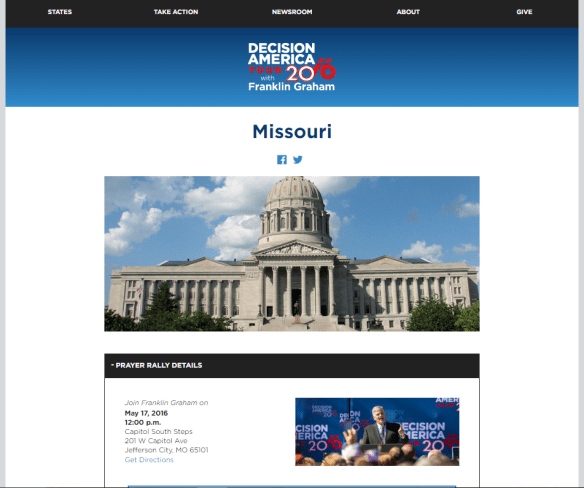
His “Decision America” rally in Missouri will be held May 17, 2016 at 12:00 noon on the Capitol South steps in Jefferson City.

Missourians prepped for legal marijuana

To date, Missouri’s Secretary of State has approved two initiative petitions to legalize marijuana for medical, commercial and recreational use. Each requires approximately 160,000 valid signatures.

The filing deadline for signed petitions to qualify for a place on the November 2016 election ballot is 5 p.m. on May 8, 2016.

Marijuana LeafPetition 2016-009 by Columbia, Mo. attorney Dan Viets, Chair of the Board of Show-Me Cannabis Regulation, proposes to amend the Missouri Constitution to:

  • allow the production, sale, distribution, and consumption of marijuana and hemp products by persons at least 21 years old;
  • permit the state to establish a tax and authorize regulations and licensing procedures;
  • change criminal provisions for marijuana offenses;
  • allow individuals who have certain marijuana-related offenses to apply to have the records relating to the offenses expunged; and to
  • allow the use of marijuana for medical purposes.

Petition 2016-013 by Nicholas Raines, president of KC Chapter of National Organization for Reform of Marijuana Laws (NORML) proposes to amend the Missouri Constitution to:

  • legalize marijuana for personal, medical, and commercial purposes;
  • release all persons who have non-violent, marijuana-related offenses from incarceration, probation, and parole, and expunge the records of their offense; and
  • prohibit state funds and law enforcement from being used to enforce federal marijuana laws.

Gradual change in Missouri laws

Jeff Mizanskey spent more than twenty years of a life term in prison for three non-violent marijuana-related crimes.

Missouri’s three strikes law was repealed in 2014, and in September 2015, Mizanskey was released on parole a few months after Governor Nixon commuted his sentence.

Missouri’s current laws and penalties will undergo one relatively small change effective January 2017. Penalties reduce to a fine only for possession of up to 10 grams although it will remain classified as a misdemeanor.

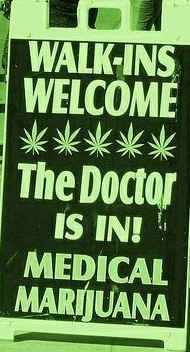
renee_rendler_kaplan_flickr_law_marijuana_doctor Medical marijuana 

Medical marijuana use is legal in twenty-three states and the District of Columbia.

In Missouri, on July 14, 2014, Governor Nixon signed HB 2238 into law allowing use of one ingredient only – cannabis oil – to treat intractable epilepsy. This “hemp extract” is defined as:

  • composed of no more than three tenths percent tetrahydrocannabinol by weight;
  • composed of at least five percent cannabidiol by weight; and
  • contains no other psychoactive substance.

Among other restrictions, the bill requires a neurologist to certify that the patient did not respond to at least three treatment options to be eligible to use the marijuana extract.

Veteran support for legalizing medical marijuana

Tom Mundell, president of the Missouri Association of Veterans Organizations says about the petition he and another activist filed with the Missouri Secretary of State on behalf of New Approach Missouri:

Not only will it provide veterans suffering illnesses much-needed relief, but it will provide invaluable resources for our underfunded veterans’ health care programs throughout Missouri.

NORML sponsored a veterans’ conference in Houston on November 14 to discuss medical marijuana for service-related injuries, chronic pain and PTSD.

Potential changes in federal law

The Veterans Administration, however, prohibits its doctors, under VHA Directive 2011-004 from even discussing, let alone prescribing medical marijuana (cannabis).

The directive expires at the end of 2015. It could be replaced by a policy more or less compatible with the U.S. Senate-passed amendment that, if enacted, would permit doctors to prescribe medical marijuana in states where it is legal.

Public opinion

Pew Research Center survey in March 2015 showed 53 percent of Americans overall favor legalizing marijuanasurveygraph

More Democrats than Republicans approve; by age groups, Millennials (18-34) approve at 68 percent while among those 70-87 years old only 29 percent approve.

Sixty-two percent do not approve of smoking marijuana in public, yet 57 percent have no problem with a business selling marijuana in their neighborhoods.

A new career opportunity

The October 2015 edition of Accounting Today magazine tells about a certified public accountant (CPA) in Colorado whose business serving the marijuana industry there is booming.

The relatively new accounting field has its problems and challenges but also the advantage of requiring an expertise that not too many professionals have achieved thus far.

Several organizations oppose legalizing marijuana

The political action committee, Citizens against Legalizing Marijuana (CALM), has all- volunteer outreaches in California and Ohio, but informs and encourages citizens Nationwide to oppose legalization.

CALM’s website quotes organizations including the American Psychiatric Association, the American Medical Association, and American Cancer Society to expose the dangers inherent in marijuana use. Further, the American Society of Addiction Medicine states that:

Marijuana is a mood-altering drug capable of producing dependency. While popularly thought to be a fairly benign ‘drug,’ marijuana can have adverse effects on memory and learning, perception, behavior and functioning, and on pregnancy.

The International Faith Based Coalition website in its Recent News column links to the Parents Opposed to Pot website and the testimony of an epileptic who wrote that smoking marijuana made seizures worse!

That individual asks marijuana users to smoke at home, not in public places where others can be affected, even intoxicated by the second-hand fumes. (He) says:

One man’s medicine can be another man’s poison.

The Drug Enforcement Agency (DEA) 2015 edition of its Drugs of Abuse report includes a section on marijuana’s origin, abuses and its effects on users. dea rpt drugs abuse

Full speed ahead

NORML’s mission is to move public opinion sufficiently to legalize the responsible use of marijuana by adults, and to serve as an advocate for consumers to assure they have access to high quality marijuana that is safe, convenient and affordable.

After securing required signatures, activist organizations like NORML will concentrate on ad campaigns. Ads will target new voters among Millennials, in  particular at universities like MU where NORML has an active chapter.

Candidate Bernie Sanders

At least one yard in the local area sports a Bernie Sanders for President campaign sign.

Yet, Missouri Democrats overall prefer Hillary Clinton 53 percent to Sanders’ 25 percent according to Public Policy Polling on August 11, 2015. BSanders

Sanders ahead elsewhere

Sanders’ popularity is a surprise to many. A recent New Hampshire poll shows him ahead of Hillary Clinton 46 percent to 30 percent and ahead of Joe Biden with 14 percent although Biden is not [yet] in the race.

WMUR Channel 9 report of September 25, 2015 says Sanders’ supporters like his ideas in general, his honesty and his support for the middle class.

What is Democratic socialism?

DemSocSanders espouses Democratic socialism defined as: a form of socialism … where the ownership and control of the means of production, capital, land, property, etc., is by the community as a whole — combined with a democratic government.

“Means of production” refers (in Marxist theory) to the raw materials and means of labour (tools, machines, etc.) employed in the production process.

“Ownership and control” under socialism according to Merriam-Webster refers to a system or condition of society in which the means of production are owned and controlled by the state.

Ha-Joon Chang and Robert Rowthorn wrote in The Role of the State in Economic Change (1995) that “…in socialism, the state is the most powerful figure that can reshape a society,” in contrast to the state in capitalism being the weaker variable that “lets the state dynamically change itself”.

Sixty-eight other socialists

WND.com article in July this year entitled “Sanders 1 of 69 Democrat socialists in Congress,” explained the “chief organizing goal” of the Democratic Socialists of America “…has been to work within the Democratic Party and remove the stigma attached to “socialism” in the eyes of most Americans.” Further, the

Democratic Party is something the public understands, and association with it takes the edge off. Stressing our Democratic Party work will establish some distance from the radical subculture and help integrate you to the milieu of the young liberals.

Workplace Democracy Act

In his September 7 Newsletter, Sanders wrote:

The surest path to the middle class for American workers is with unions. The security and strength of a union job means that workers can have good pay, health care, and a voice at work.

He will propose legislation this fall as the Workplace Democracy Act. Sanders believes the middle class is disappearing as a direct result of limitations on the right to form unions and to bargain collectively.

The Act he proposes would:

  • Ensure companies can’t prevent workers from getting a first contract.
  • Make it easier for workers to form unions through a majority sign up process.
  • Strengthen the enforcement when corporations break the law.

Sanders’ other campaign themes

In his August 30, 2015 Newsletter, Sanders listed his key campaign issues as:

  • Income and wealth inequality
  • Jobs and income
  • Campaign finance reform
  • Climate change
  • College affordability
  • Health care
  • Poverty
  • Tax reform

Just another $18 trillion…

Sanders says the $18 trillion the Wall Street Journal calculates to be the cost of his programs is over-exaggerated. A single-payer system under Medicare and higher taxes on the wealthy will reduce that amount, he said.

Stephen Wolf of the Daily Kos believes America will not elect him because Sanders as a “socialist”is too radical to win the 2016 election. Nevertheless, Wolf opines:

Ultimately, we should want a democratic socialist government to shape society for the benefit of all.

Socialism and the Bible

Some Christians believe socialism is biblical. Morgan Guyton, Associate Pastor of the United Methodist Church in Burke, Va., wrote:

…But regarding those aspects of human need like health care and housing that require greater resources than even large megachurches can muster, I don’t see why Christians should fight tooth and nail to prevent God from using our secular government to provide for these needs.

Dr. Joel McDurmon writing for American Vision expressed an opposing view in an August 15, 2015 article:

The measures are socialistic if by socialism you mean private application of charity by individuals, families, and churches in order to benefit the poor and needy of society. It is emphatically not socialism if by that label you mean taxation and redistribution enforced by the State’s gun. Big difference.

Images under Creative Commons license